

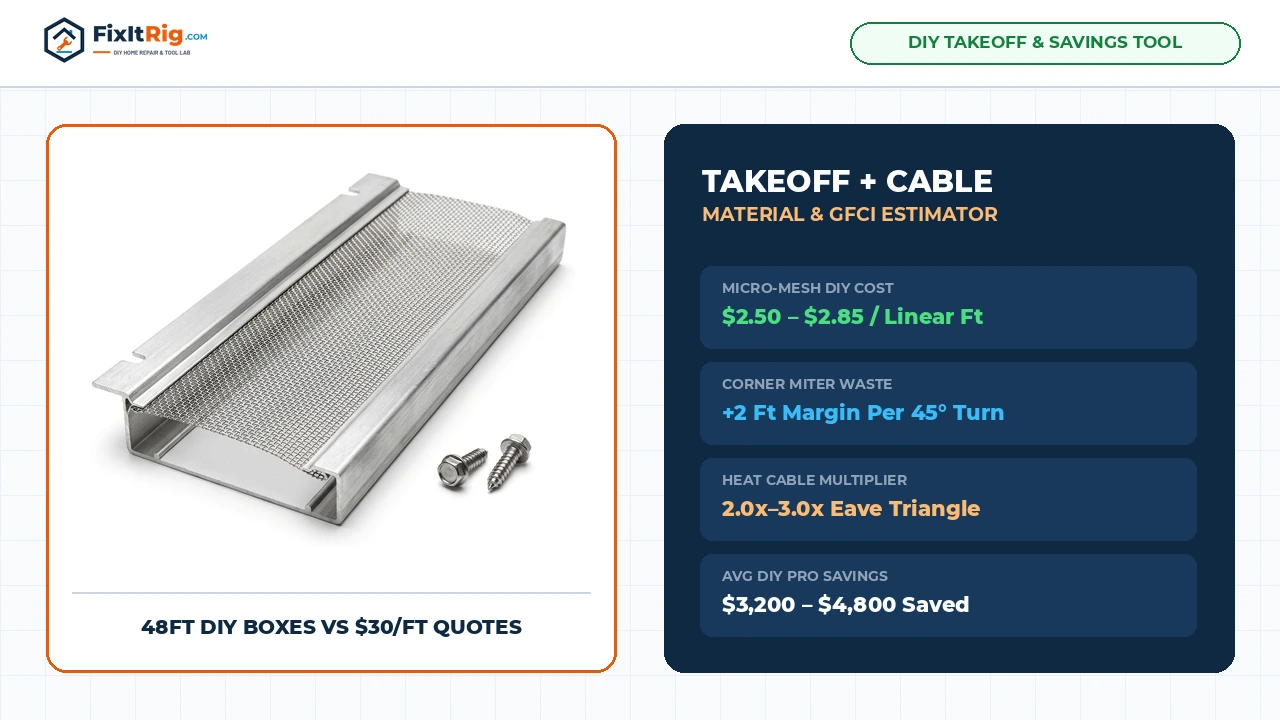
DIY Gutter Guard Boxes & Roof Heating Cable Cost Estimator
Calculate exact 48ft micro-mesh boxes needed (with corner waste), savings versus contractor quotes ($28/ft avg), and winter heat-cable footage.
DIY Micro-Mesh Savings ($3,200+ Saved) & Winter Cable GFCI Sizing
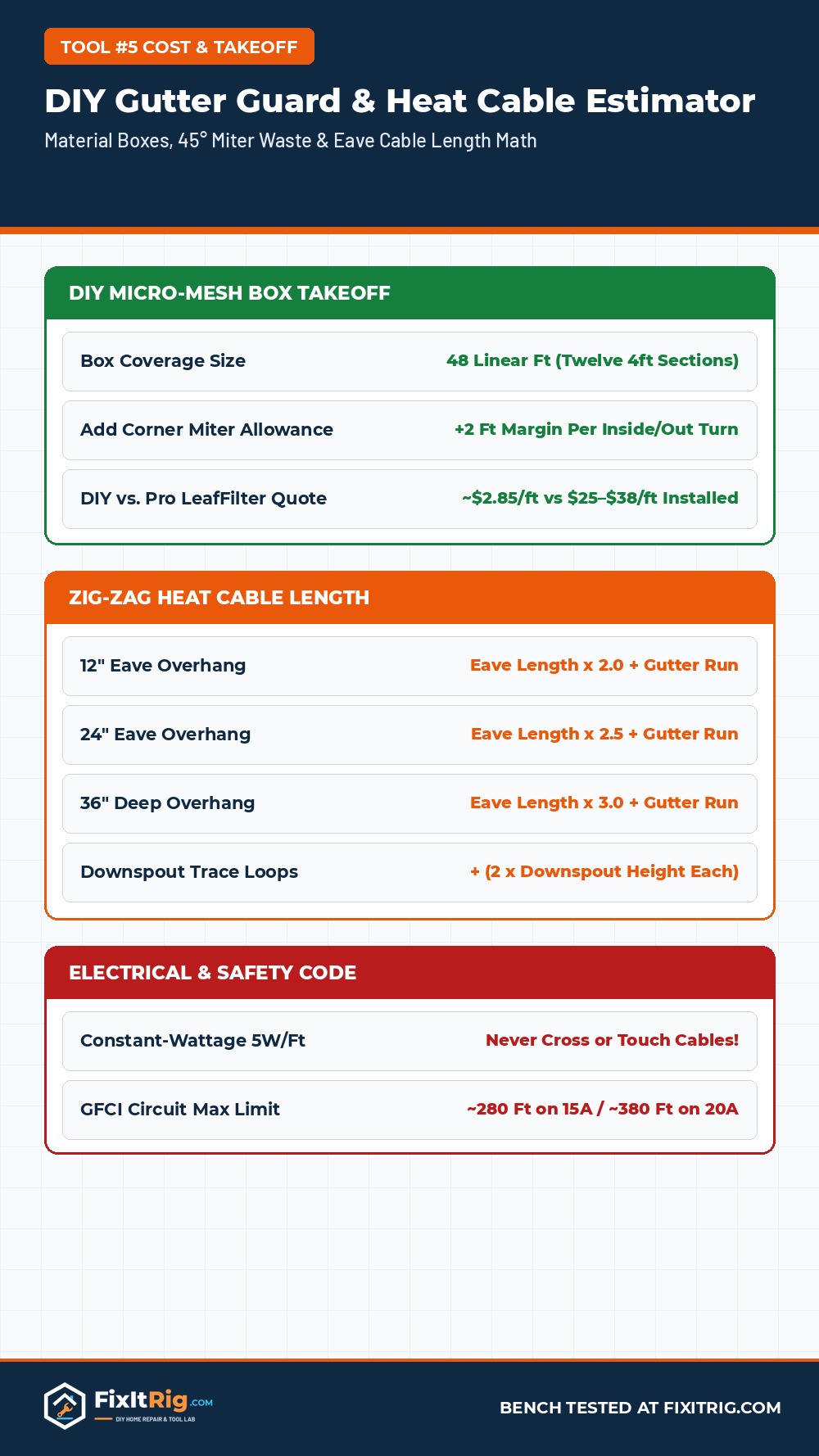
National franchise gutter guard salespeople routinely quote $25 to $38 per linear foot ($3,750 to $5,700 on a typical 150-foot home) for essentially identical stainless steel micro-mesh hardware you can order in 48-foot DIY boxes for ~$140 per kit. Accounting for 1.5–2 feet of 45-degree corner miter waste per turn, a 150-foot perimeter takes just 4 boxes (~$560 total)—leaving over $3,600 in your pocket for a single weekend install. In heavy snow zones, size de-icing cable at 2.0x to 3.5x north eave length plus double downspout drops.
Homeowners sitting through two-hour kitchen-table pitches from national gutter guard franchises rarely receive an itemized material breakdown. When an estimator measures 150 linear feet of 5-inch residential gutter and quotes $4,200 to $5,400 for stainless micro-mesh covers, less than 15 percent of that bill goes toward aluminum rails and woven wire cloth—over 85 percent pays commission overhead, high-pressure sales software, and truck wrapping. Ordering proven heavy-gauge DIY panels such as Raptor Type 304 Stainless Micro-Mesh or Flexxpoint 30-Year Covers delivers near-identical pine needle filtration for roughly $2.60 to $2.95 per linear foot.
However, estimating a clean DIY order requires two practical site measurements people routinely forget until halfway up a Saturday extension ladder: inside and outside 45-degree corner miter offcut waste (causing an exact 144-foot house perimeter to run three feet short with three boxes) and winter roof heat-cable triangle math where cold shaded valleys sit over warm uninsulated overhangs. Our Cost & Takeoff Estimator above generates exact box counts, pro quote savings, and safe heat cable footages simultaneously.
Why 45-Degree Gutter Corners Add Hidden Waste to DIY Guard Box Counts
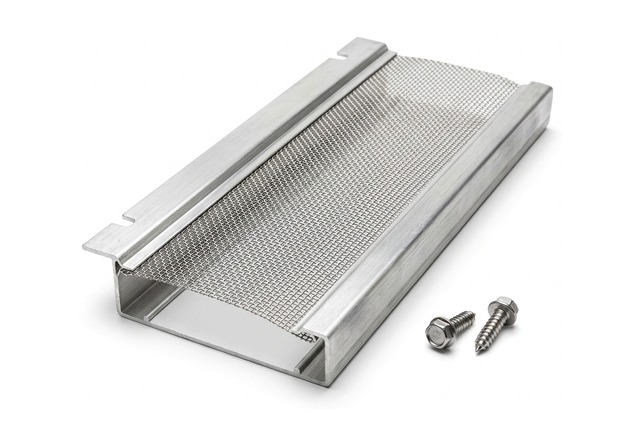
Every manufacturer packs DIY micro-mesh guards in rigid 4-foot extruded panels—usually boxed in convenient 48-linear-foot cartons (twelve panels plus #8 stainless self-tapping hex screws and a magnetic driver chuck). Measuring house siding tightly to 144 feet and ordering exactly three 48-foot boxes (“144 ÷ 48 = 3”) almost always forces an emergency pause on Sunday afternoon.
- Inside Valley & Outside Hip Miter Cuts (+1.5 to 2.0 ft per corner): Every L-shaped outside porch corner or 90-degree dormer inside valley forces you to cut overlapping 45-degree diagonal miters with red/green aviation snips. Because the cut diagonal leg cannot cleanly flip backward to fit an adjacent right-hand miter without misaligned rain ribs, you typically sacrifice 12 to 20 inches of trimmed waste at every corner junction—plus a slight 1/2-inch stainless mesh flap overlap between 4-foot rails.
- 6-Inch Oversized Troughs Cost Slightly More Than 5-Inch Kits: Before clicking add-to-cart, check your front gutter lip width with a tape measure. Five-inch K-style kits fit troughs measuring roughly 4.75″ to 5.15″ top-to-front; six-inch commercial/steep-roof profiles demand wide 6-inch guard rails ($155–$170 per 48ft box) so water sheets drop straight inside the basin rather than bypassing short panels. Study complete box dimensions and cut diagrams in our Raptor Gutter Guard 48ft Bench Review.
| Home Perimeter (Linear Ft) | Est. Miter Corners | 48ft DIY Kits Needed | Est. DIY Material Cost | Typical Pro Quote ($28/ft Avg) | Your DIY Savings |
|---|---|---|---|---|---|
| 100 linear ft (Townhome / Ranch) | 4 Corners | 3 Boxes (144 ft) | ~$420 | ~$2,800 | ~$2,380 Saved |
| 150 linear ft (Avg Colonial) | 6 Corners | 4 Boxes (192 ft) | ~$560 | ~$4,200 | ~$3,640 Saved |
| 200 linear ft (Large 2-Story) | 8 Corners | 5 Boxes (240 ft) | ~$700 | ~$5,600 | ~$4,900 Saved |
| 250 linear ft (Wraparound Porch) | 10 Corners | 6 Boxes (288 ft) | ~$840 | ~$7,000 | ~$6,160 Saved |
| 300 linear ft (Custom Hip Home) | 12 Corners | 7 Boxes (336 ft) | ~$980 | ~$8,400 | ~$7,420 Saved |
Roof De-Icing Cable Geometry: Why Straight Line Eave Footage Is Never Enough
Stretching one straight heating cord across the inside floor of your gutter never prevents ice dams from backing cold water upward beneath roof shingles. By the time snowpack freezes solidly six inches above the aluminum gutter rim along a cold unheated roof soffit overhang, meltwater pools inside a frozen moat resting behind the drip edge and floods attic soffits regardless of whether your gutter itself stays melted.
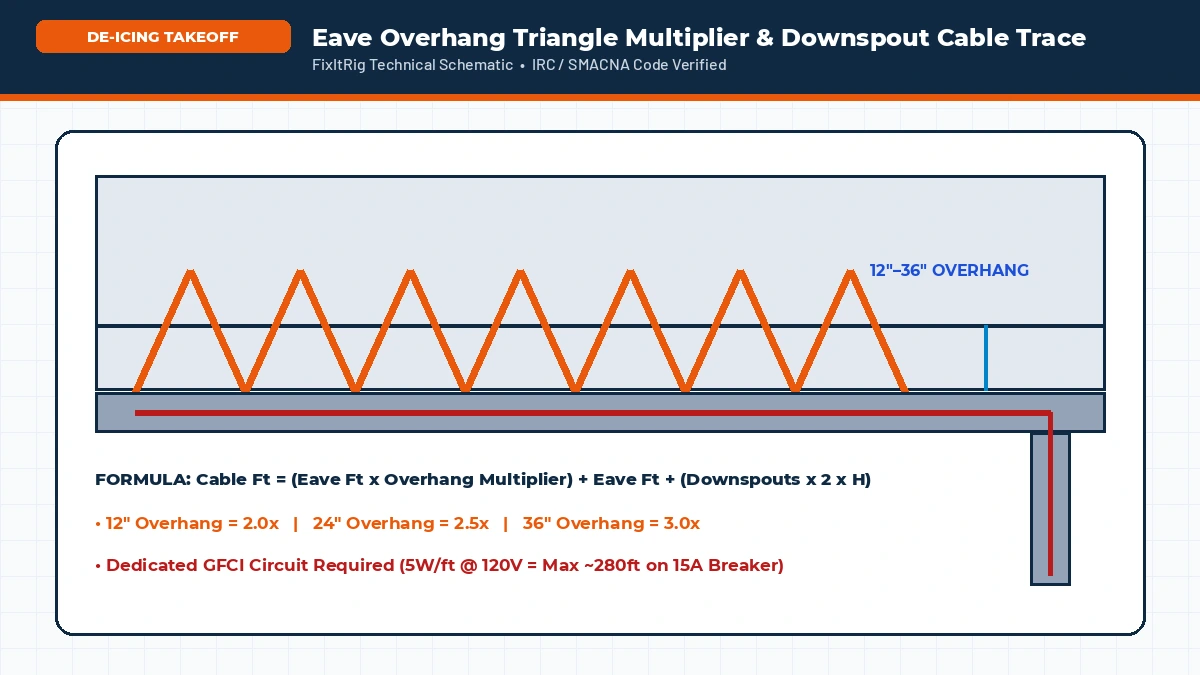
Effective roof de-icing requires creating continuous meltwater drainage channels extending vertically past the warm exterior house wall plate—laid in classic triangular zig-zag waves clipped smoothly onto lower shingle courses:
- The Zig-Zag Overhang Multiplier (2.0x to 3.5x): Measure your eaves overhang distance from fascia wall back inside to heated living-room siding. A compact 12-inch overhang requires zig-zag triangles tall enough to cross roughly 18 inches up roof tabs (multiplier 2.0x); a deeper 24-inch colonial soffit overhang requires higher shingle triangles (2.8x); and wide 36-inch porch eaves jump to 3.5x heated eave footage—often only applied across shaded northern elevations and inside steep valleys rather than wrapping sunny southern walls unnecessarily.
- Add Horizontal Gutter Trace + Double Downspout Drops: Every horizontal foot along the heated eave needs one continuous heating strand sitting gently along the inside gutter trough bottom (or over micro-mesh edges in mild ice zones), PLUS a hairpin 2x vertical downspout loop diving down to ground splash elevation and climbing back out so melted roof water does not refreeze solidly inside shaded vertical aluminum pipe!
Electrical & Micro-Mesh Safety Warning: Never Overlap Constant-Wattage Heating Cables
Standard orange/black big-box roof de-icing kits (like Frost King RC Series) use constant-wattage 5W-per-foot fixed resistance wire: if two sections ever touch, cross over each other inside a gutter corner, or get pinched under heavy steel clips, localized heat skyrockets and melts PVC insulation jackets—causing GFCI trips or roof scorching! Equally critical on electrical capacity: under NEC continuous load rules (80% maximum breaker load), a standard 15-amp 120V GFCI outdoor outlet supports at most ~280 linear feet (1,440W max) of 5W/ft cable, while a dedicated 20-amp GFCI circuit supports ~380 feet (1,920W max). Long wraparound eaves over 280 feet must split onto two independent GFCI circuits—or upgrade to self-regulating commercial heat cable (like nVent Raychem FrostGuard) whose semi-conductive polymer core lowers output safely if wires cross.
Pairing Heat Cables With Stainless Micro-Mesh Gutter Guards Safely
A common question in northern snow states—from Minnesota across upstate New York and Colorado—is whether adding DIY micro-mesh covers blocks zig-zag roof cables or increases winter icicles. Follow these field-tested rules when combining guards and heat wire:
- Mount Zig-Zag Cable Peaks Strictly Onto Shingles—Never Under Guards: Clip aluminum shingle V-clips gently around lower shingle tab corners cleanly using light plier tension (zero roofing nails that pierce asphalt waterproofing!). Terminate the bottom zig-zag vertex gently resting onto the metal fascia hem or front aluminum rail lip of your micro-mesh guard rather than weaving constant-wattage cord through narrow under-guard drop holes.
- Compare Constant-Wattage vs. Self-Regulating Roof Cable Economics: Economy fixed-wattage kits (such as Frost King RC60–RC240) cost roughly $0.80–$1.10 per foot and emit steady 5 watts per foot regardless of ambient sun exposure—meaning warm bare asphalt shingles bake idle cable jackets slowly unless unplugged each April or wired to an outdoor roof sensor. Self-regulating semi-conductive cables (such as nVent Raychem FrostGuard or EasyHeat SR Trace) dynamically raise output toward 8W/ft when submerged inside freezing ice slush and taper downward safely around warm dry metal trim, preventing burnouts inside tight inside roof valleys where snow banks pack deepest.
- Fix Root Attic Heat Loss Before Buying 400 Feet of Cable: Heating cables fight symptoms by melting safe runoff highways through frozen eaves; they consume electricity all winter and cannot survive ice sliding violently off standing-seam metal roofs without heavy snow retention bars. Always pair de-icing tape with passive roof-deck cooling audited via our Attic Ventilation NFA Intake & Exhaust Calculator.
- Choose Aluminum Frame Guards Over Vinyl Plastic Around Heat Trace: Never lay hot constant-wattage cable across thin PVC vinyl plastic snap-in guards or open sponge foam inserts! Extruded aluminum micro-mesh housings like Raptor or aluminum louvered Flexxpoint 30-Year covers conduct cable heat evenly without softening, cracking, or off-gassing at 120°F. Also double-check gutter roof-apron flashing clearances before clamping roof cables on steep architectural shingles so melting roof water tracks smoothly down open channels all the way out past your basement foundation walls.
Weekend DIY Installation Blueprint (Under 6 Hours for 150 Ft)
Once your box takeoff arrives, prepare clean dry gutters safely before screwing down your first 4-foot panel:
- Deep-Clean Gutters & Test Downspout Slope First: Scoop damp pine straw cleanly from a stabilized ladder cleared past the front bead with a Werner AC78 standoff stabilizer, or blast grit smoothly from ground turf via our Telescoping Wand Safe PSI Calculator. Verify trough slope falls evenly 1/4 inch per 10 feet toward 3″x4″ drop outlets.
- Cut Clean 45° Inside & Outside Corners With Compound Snips: Use yellow straight-cut aviation snips for aluminum trim rails and stainless shears to trim 1/2-inch mesh flaps overlapping smoothly inside corner valleys—blocking pine needles from slipping down corner seams.
- Fasten Every 12 Inches With #8 Hex Zip Screws: Drive pre-coated stainless #8 x 1/2″ hex screws smoothly down the outer front gutter lip and rear hanger flanges without sliding panels underneath brittle lower asphalt shingles—preserving factory shingle manufacturer warranties completely. Compare all fastening systems in our 7 Best DIY Micro-Mesh Gutter Guards guide.
Complete DIY Guard & Winter Heat Cable Hardware Kit
Type 304 stainless micro-mesh (~900 holes/sq in) framed in extruded anodized aluminum with magnetic hex bit and self-tapping zip screws (save $3,000+ vs pro quotes).
Pre-assembled 5W/ft weatherproof heating cable complete with non-nailing aluminum shingle roof clips and gutter downspout spacer hangers.
Commercial-grade self-regulating cable safely adjusting wattage output dynamically in ice-heavy valleys with zero overheat burnout risk if wires touch.
Cleanly slices aluminum guard extrusions at 45-degree corner miters and secures stainless hex screws smoothly without stripping drill chucks.
Frequently Asked Questions
Why do professional gutter guard quotes cost $3,500 to $6,000 when DIY kits are under $600?
Door-to-door franchise gutter companies spend roughly 30% to 40% of project revenue on digital lead ads, commission salespeople, and branded truck fleets—passing massive customer acquisition fees onto the per-foot quote ($25–$38/ft). Purchasing heavy Type 304 stainless DIY kits like Raptor directly removes the middleman completely while keeping comparable extruded frame & mesh durability.
Do leftover 4-foot guard sections return easily if I order one extra buffer box?
Yes—ordering one unopened buffer carton prevents stalling mid-project over unusual bay-window miter cuts, and unopened 48-foot boxes store flat in a garage rafter or return seamlessly inside normal Amazon retail return windows if unused.
Can I cut constant-wattage Frost King roof heat cable shorter if my kit turns out too long?
Never cut constant-wattage fixed-resistance roof cables (covered side by side in our Frost King vs. EasyHeat Roof De-Icing Cable comparison)! Shortening constant-wattage heating cord drops loop electrical resistance catastrophically—causing overheating, melted roof shingles, or immediate circuit breaker tripping. Always measure zig-zag footage accurately using our calculator above first and select an exact factory kit length (e.g., 60ft, 100ft, 160ft, 200ft, or 240ft).
Do roof heating cables need to run all winter long 24/7?
No—running constant-wattage heat cables unnecessarily over dry 45°F sunny afternoons wastes electricity. Plug outdoor kits into an automatic ambient thermostat + moisture sensor controller (like Roof & Gutter Heat Cable Controllers firing strictly between 20°F and 38°F when wet melt snow triggers moisture contacts) to trim winter electric usage by 60%+.
Will installing micro-mesh gutter guards keep basement downspouts from freezing shut?
Micro-mesh keeps wet rotting oak leaves from damming up 2″x3″ elbows and trapping standing icy water plugs—a top trigger behind split exterior downspouts! Pair micro-mesh covers with roomy 3″x4″ drop outlets evaluated in Gutter & Downspout Rainfall Capacity Calculator and solid underground pop-up drain lines.
What happens if roofers need to replace my shingles five years after installing DIY Raptor guards?
Because Raptor fastens exclusively with #8 removable hex screws onto the top front nose bead of the gutter without pinning under lower roof tabs, any future roofing crew can unscrew panels cleanly in 45 minutes with a 1/4″ cordless nut driver, re-roof undisturbed, and screw the stainless panels straight back down.
Can I install DIY gutter guards over budget brush fillers or snap-in vinyl covers?
Remove old deteriorated bristle brushes or brittle warped PVC screens completely before installing extruded aluminum micro-mesh rails. Compare long-term clog buildup curves across entry-level options inside Amerimax Lock-In vs. GutterBrush.