

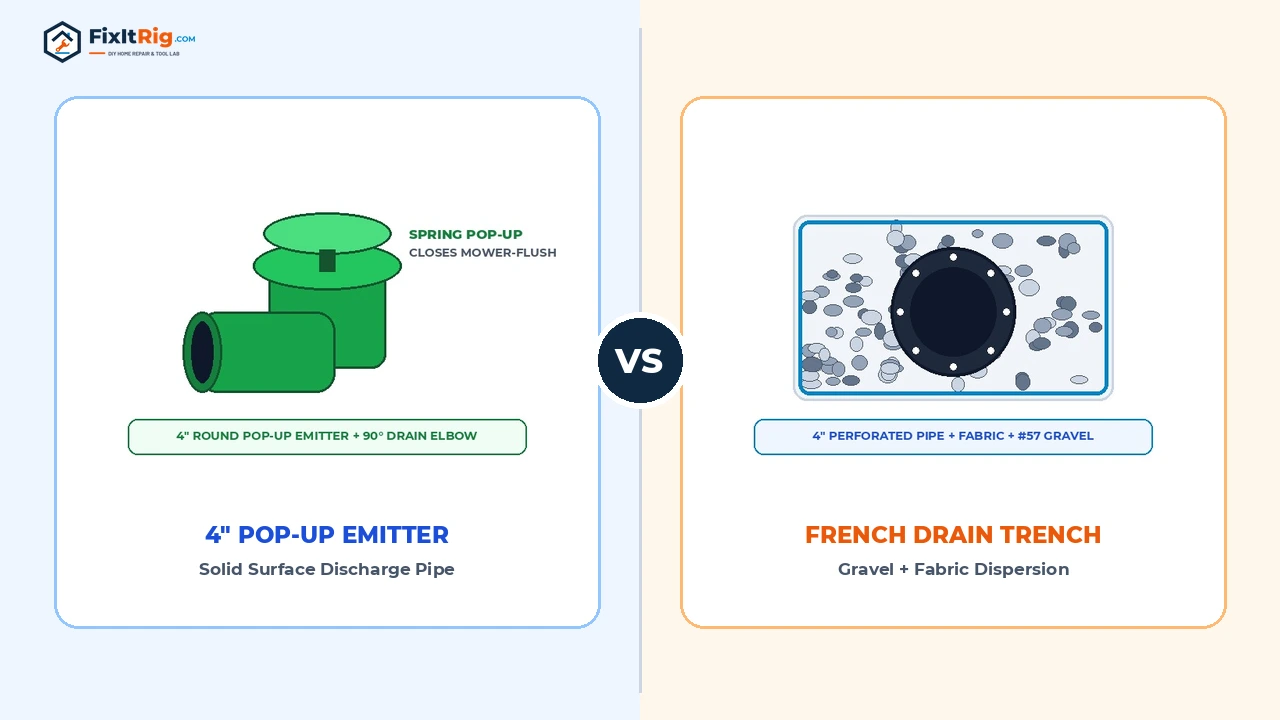
Nothing floods a basement or cracks a concrete driveway slab faster than dumping fifty gallons per minute of roof runoff directly onto clay soil two feet outside your foundation wall. Once homeowners realize short 24-inch splash blocks won’t save their crawlspace, two buried yard drainage solutions immediately dominate every landscaping recommendation: installing a solid pipe leading to a flush Pop-Up Drainage Emitter or digging a gravel-filled French Drain trench.
Connecting downspouts into the wrong underground system is one of the costliest mistakes in residential DIY plumbing. Dumping unfiltered shingle grit and autumn oak leaves directly into a perforated gravel French drain chokes stone pores solid inside two years, forcing you to tear up your entire backyard lawn. Here is our exact engineering comparison showing where a Pop-Up Emitter beats a French Drain—and when combining both with a solid SDR-35 trunk line is the smartest play.
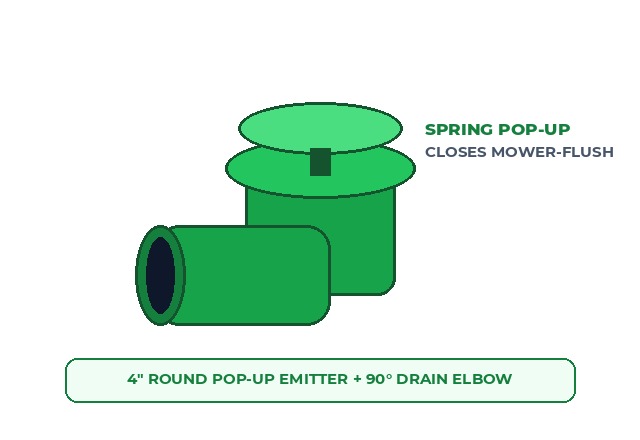
Solid Pipe + Pop-Up Emitter
Smooth-wall 4-inch PVC SDR-35 underground line discharging roof runoff harmlessly across sloped grass.
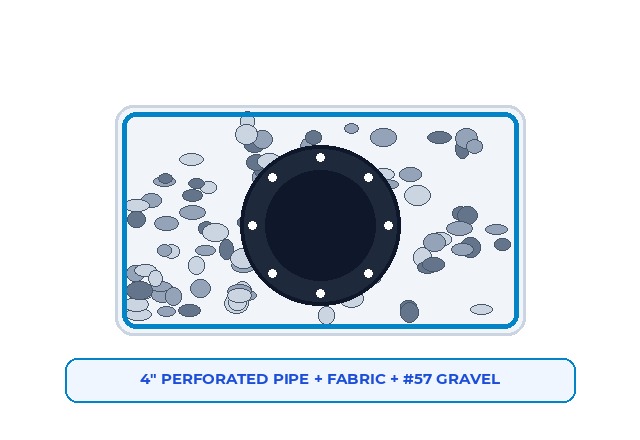
Gravel French Drain Trench
Perforated 4-inch pipe surrounded by #57 washed stone and filter fabric capturing spongy subsurface turf water.
Choose Solid Pipe + Pop-Up Emitter If…
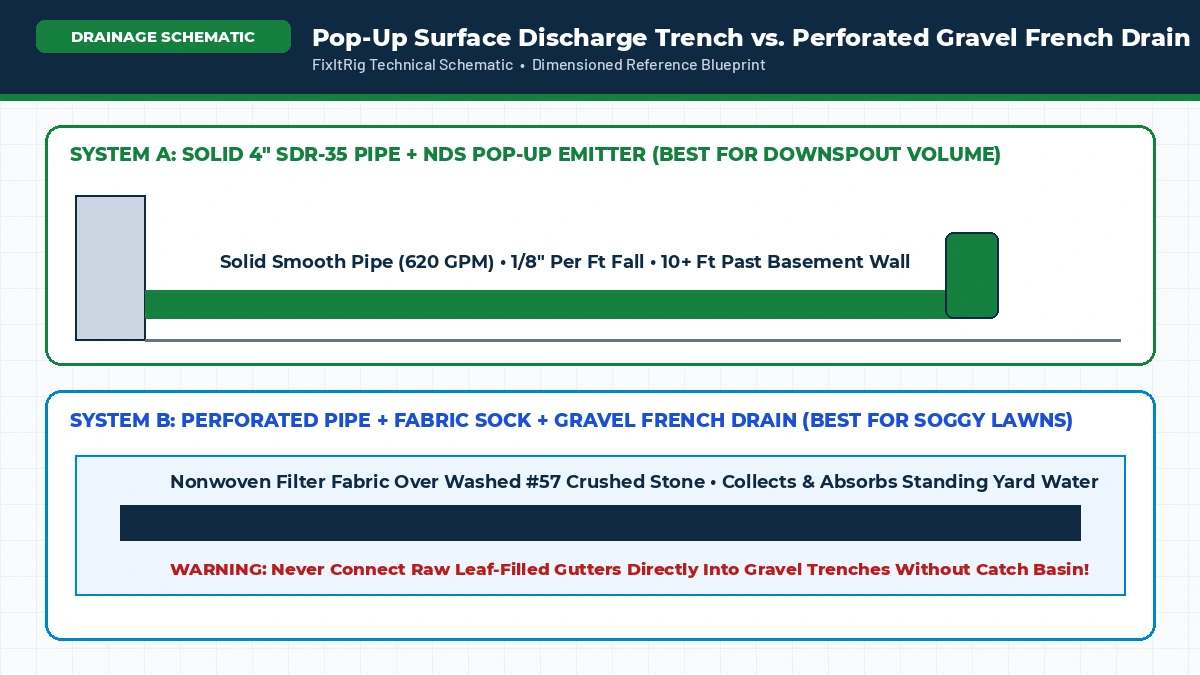
- You are piping roof downspouts: Handles 550–620 GPM blasts rapidly with zero gravel mud contamination or pipe root invasion.
- You have positive yard slope toward a curb or swale: 1/8″ per foot fall clears water effortlessly 10–25 feet past basement walls.
- You want minimal digging & budget cost: A shallow 6-inch spade trench costs less than a third of importing bulk #57 stone.
Choose a French Drain Trench If…
- You have pooling groundwater in flat clay lawns: Intercepts soggy yard runoff sitting above hardpan clay or along retaining walls.
- Downstream slopes are dead flat (Zero Daylight): Acts as an underground gravel holding vault that slowly percolates rain into lower subsoil.
- You install it on a SEPARATE line from downspouts: Keep dirty roof debris out unless pre-filtered by a dual-port catch basin.
Drainage Performance Scorecard (Downspout Runoff Focus)
Hydraulic Rules: Why Connecting Downspouts to a French Drain Fails
Every homeowner considering underground pipes should memorize one core civil engineering rule: solid pipe moves concentrated roof water away; perforated pipe collects diffuse ground water. When a heavy thunderstorm pours across your roof, downspouts don’t just carry clean water—they flush roof moss, decomposed oak leaves, pine needles, and coarse asphalt shingle grit at 40 to 100 GPM.
If you feed that dirty storm stream directly into a perforated French drain trench wrapped in landscape fabric, fine asphalt sediment washes directly out the perforations and clogs the surrounding fabric pores like mud mortar within 18 to 36 months. Worse, if the trench passes within 6 feet of your foundation while sloped imperfectly, pouring 50 GPM through perforated holes actually injects roof water into the soil right beside your basement wall! Always carry roof water through unperforated smooth solid pipe (ideally rigid green/white 4″ PVC SDR-35 or solid dual-wall HDPE) all the way past the 10-foot perimeter.
Corrugated Single-Wall vs. Rigid 4″ PVC SDR-35 Pipe
Choosing the right pipe inside your Pop-Up Emitter trench matters just as much as choosing the emitter lid. Home improvement centers stock cheap black single-wall corrugated tubing in 100-foot coils alongside straight 10-foot sticks of green or white 4″ PVC SDR-35 (ASTM D2729 / D3034 thin-wall sewer-and-drain pipe). Here is why SDR-35 outperforms cheap coiled tubing:
| Pipe Specification | 4″ PVC SDR-35 (Rigid Solid) | Black Corrugated Single-Wall | Dual-Wall HDPE (Smooth Core) |
|---|---|---|---|
| Interior Friction | Glass-smooth interior (620 GPM max) | Corrugated ridges trap shingle grit (-35% flow) | Smooth interior, strong rings |
| Crush Load Rating | Withstands heavy lawn tractors & frost heave | Crushes easily under wheelbarrows / roots | High crush strength (Pro choice) |
| Grade / Slope Accuracy | Maintains laser-straight 1/8″ per ft slope | Coils ripple up & create standing water bellies | Straight sticks hold clean grade |
| DIY Cost Per 10 Ft | ~$16 – $21 / 10ft stick | ~$11 – $14 / 10ft equivalent | ~$19 – $24 / 10ft stick |
How to Install an NDS Pop-Up Emitter That Never Freezes or Floods
Many DIYers complain that their underground pop-up pipe smells like stagnant mosquito water or backs up during winter freezes. Both problems happen when installers forget the gravel weep pocket under the final 90-degree emitter elbow:
- Verify Your House Discharge Volume: Calculate total roof GPM feeding that corner using our Gutter & Downspout Capacity Calculator. Two combined 3″x4″ downspouts dumping 90+ GPM need at least a 4-inch SDR-35 trunk line (never 3-inch pipe).
- Dig a Clean 1% to 2% Continuous Trench Slope: Trench out at least 10 to 15 feet from foundation walls into a downhill lawn slope (dropping 1/8″ to 1/4″ per linear foot). Remove rocks along the trench floor so pipe doesn’t bow upward mid-run.
- Connect at the Wall With a Cleanout Debris Filter: Attach your vertical downspout into the buried 4″ line using a rectangular NDS 9P06 or 9P07 adapter—or insert a vented leaf screen (such as an angled Downspout Filter / Cleanout Tee) 18 inches above ground so tree twigs never enter the underground pipe.
- Build a 12″ Pea Gravel Sump Beneath the Emitter Elbow: At the grass discharge point, drill three 3/8-inch drain holes straight through the bottom belly of the NDS 90-degree elbow, set the elbow directly over a 12-inch deep bed of #57 washed gravel wrapped in filter cloth, and leave the emitter rim 1/2″ recessed below turf crown so mower blades glide over harmlessly. When storms stop, standing water inside the vertical elbow drains straight down into the gravel bed—preventing mosquito breeding AND cracked elbows during sub-zero winter nights!
When to Build a Hybrid Dry Well / Catch Basin + French Drain
What if your home sits on a totally flat suburban lot surrounded by neighbor fences—leaving nowhere downhill for a Pop-Up Emitter to discharge without flooding your neighbor’s lawn? Here is the proven two-stage solution civil engineers use:
- Stage 1 (Transport): Run your downspout cleanly through solid 4″ SDR-35 pipe into a buried 12″x12″ NDS Catch Basin Sump placed 10 to 12 feet away from the foundation wall. The sump bottom catches heavy shingle sand and decomposed leaves before water continues onward.
- Stage 2 (Percolation Chamber / Dry Well): From the catch basin outlet port (raised 4 inches above the sump floor), connect into either a 50-gallon buried NDS Flo-Well gravel dry well OR a 25-foot deep French drain infiltration trench filled with washed #57 crushed stone wrapped completely in 4-oz needle-punched nonwoven geotextile fabric. Clean roof water exits gently into subsoil porosity while solids remain trapped inside the cleanable sump!

Solid Pipe + Pop-Up Pros
- Moves full 620 GPM roof floods cleanly off property in seconds
- Tiny 6″ trench width keeps turf disturbance minimal
- Zero heavy bulk gravel wheelbarrows needed along most runs
French Drain Caveats
- Never connect raw gutter spouts directly without a sediment catch basin
- Requires excavating 1,000+ lbs of dirt & hauling #57 clean crushed gravel
- Black silt sock tubing clogs permanently in dense red clay unless surrounded by thick stone
Pre-Dig Safety, 811 Utility Locates & HOA Curb Runoff Rules
Before sinking a trenching spade four inches beneath turf near house walls, take two critical legal and safety steps that prevent catastrophic property repairs:
- Call 811 at Least 72 Hours Before Digging: Even a shallow 8-inch Pop-Up Emitter trench routinely crosses buried coaxial fiber-optic internet drops (often buried barely 2 inches below sod!), sprinkler zone manifold wiring, low-voltage landscape transformer lines, and shallow natural gas service feeds. Calling 811 nationwide is free and marks utility corridors accurately before you swing a mattock.
- Check Municipal Storm Curb & Neighbor Setback Rules: Never aim a 4″ Pop-Up Emitter closer than 5 feet from a neighbor’s property fence or terminate solid pipe directly through a concrete city street curb without municipal permission. Most US suburban codes allow surface pop-up emitters set 8 to 12 feet back from public sidewalks so clean lawn grass filters sheet flow naturally before entering municipal storm grates.
- Prevent Root Intrusion Around Maples & Willows: Silver maples, river birches, and weeping willows smell constant moisture inside perforated French drains and push dense hair-root mats directly through fabric socks within four years. Whenever trenching past thirsty mature trees, run solid glued Schedule 40 or gasketed SDR-35 PVC past root drip zones.
Quick 24-Hour Clay Percolation Jar Test Before Choosing a French Drain
Before trenching two tons of heavy crushed stone across backyard turf, spend fifteen minutes verifying whether native backyard dirt actually absorbs standing groundwater cleanly. Dig a test hole twelve inches wide by eighteen inches deep along the planned path, fill the pit completely to top soil grade with a garden hose, let soil walls saturate overnight, then refill clean water to depth and drop in a yardstick to record hourly water fall.
If water drops faster than one inch per hour, sandy loam or glacial till drains perforated French trenches reliably even without downhill daylight. Conversely, if rainwater sits stagnant for six hours inside sticky red or gray claypan subsoil, burying gravel trenches without an open downhill curb exit only creates an underground swimming pool! On heavy claypan yards, solid 4″ SDR-35 transport pipe carrying gutter storm surges outward to a sunlit grass NDS Pop-Up Emitter on sloping turf beats holding pits every time.
Exact Hardware Checklist for Weekend Yard Drainage
Mower-safe UV-stabilized green cap pops open cleanly under hydrostatic flow and seals shut against critters.
Exact sleeve coupling matching residential metal downspouts securely into 4″ SDR-35 or corrugated drain pipe.
Captures wet shingle granules and leaves upstream before water enters dry wells or infiltration trenches.
Frequently Asked Questions
Will grass grow completely over a Pop-Up Emitter cap and block water?
St. Augustine, Bermuda, and thick fescue runners will gradually creep over the green plastic rim once a year. Simply trim a 1-inch turf halo around the emitter lid every spring with a flat edging spade or string trimmer—checking that the lid lifts smoothly by hand.
How deep should I bury a 4-inch downspout pipe?
Keep the pipe crown buried at least 3 to 4 inches below lawn sod to survive riding lawnmower weight, with at least a 1/8-inch drop per linear foot toward the exit. Avoid burying deeper than necessary unless driving across gravel driveways (use Schedule 40 PVC under driveways).
Do pop-up emitters freeze shut in Minnesota, Michigan, or Northeast winters?
If you forget the weep holes and #57 pea gravel sump beneath the final 90-degree elbow, water pools inside the bottom curve, freezes solid, and blocks mid-winter thaws. Adding three 3/8-inch drill holes over a 12-inch gravel pocket drains the pipe dry after every thaw so the cap stays ice-free.
Can I tie two or three downspouts into a single buried 4-inch pipe?
Two 2″x3″ spouts or up to 1,400 total square feet of roof area drain comfortably inside one 4-inch solid PVC SDR-35 trunk pipe using 45-degree wye fittings (never blunt 90-degree tees). If merging three or more heavy roof zones, step up the main trunk to 6-inch SDR-35 or run a second parallel 4-inch line.
Is black corrugated pipe with a pre-installed sock fine for a French drain without gravel?
No! Thin knitted fabric socks wrapped directly around corrugated ridges clog with fine clay silt rapidly. Real French drains surround the pipe with 4 to 6 inches of clean washed #57 crushed stone and wrap the outside trench perimeter in nonwoven 4-oz geotextile fabric—like a giant stone burrito.
What if I don’t want to dig trenches across tree roots or irrigation sprinkler lines?
Where oak roots or sprinkler lines block trenching within 6 feet of your house, install Amerimax Stealth Flow low-profile yard diffusers hidden cleanly beneath 2 inches of landscaping bark mulch instead.