

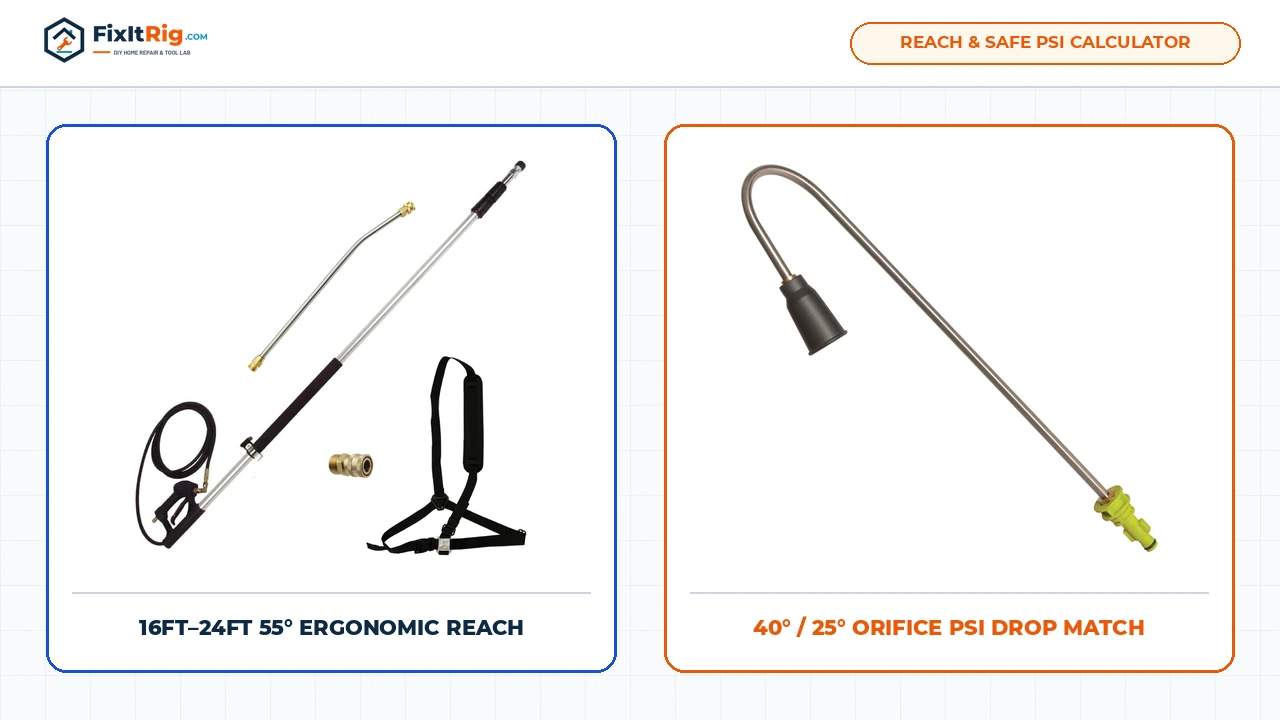
Pressure Washer Gutter Wand Reach & Safe PSI Calculator
Check the exact telescoping wand length needed for a comfortable 55° ground stance and prevent cracking vinyl or denting aluminum gutters.
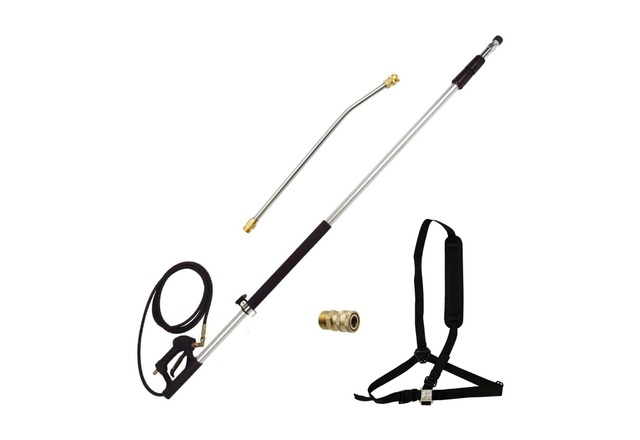
Matching Pole Length, Orifice Number & Gutter Material Safely
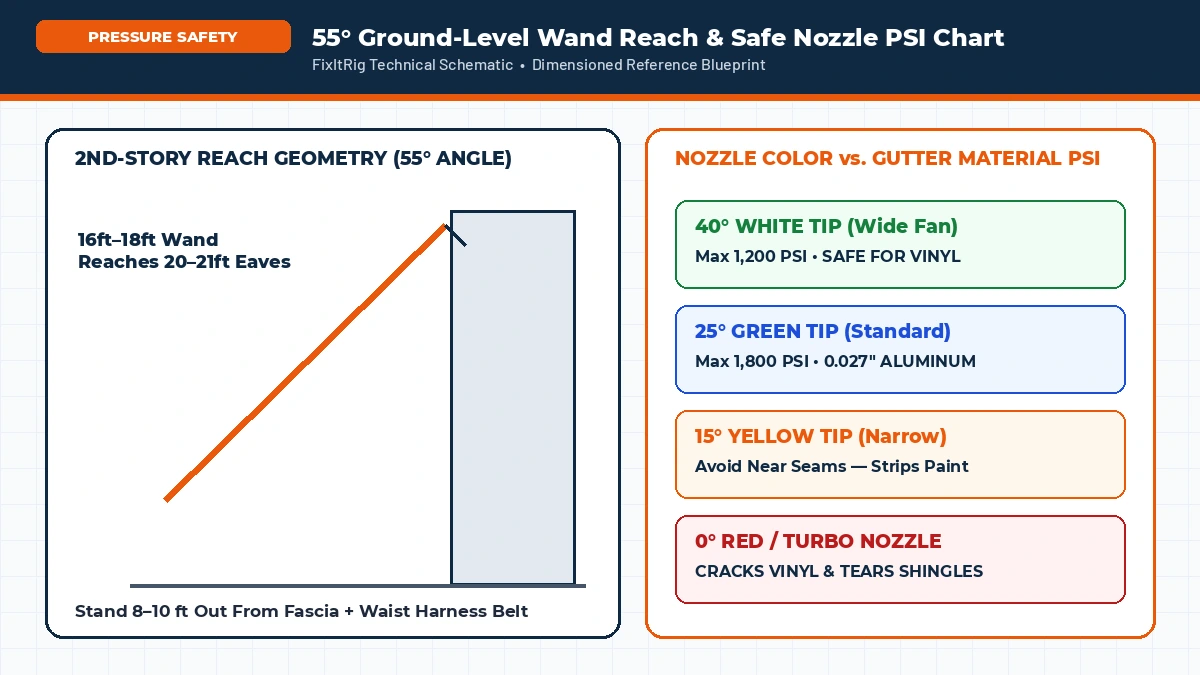
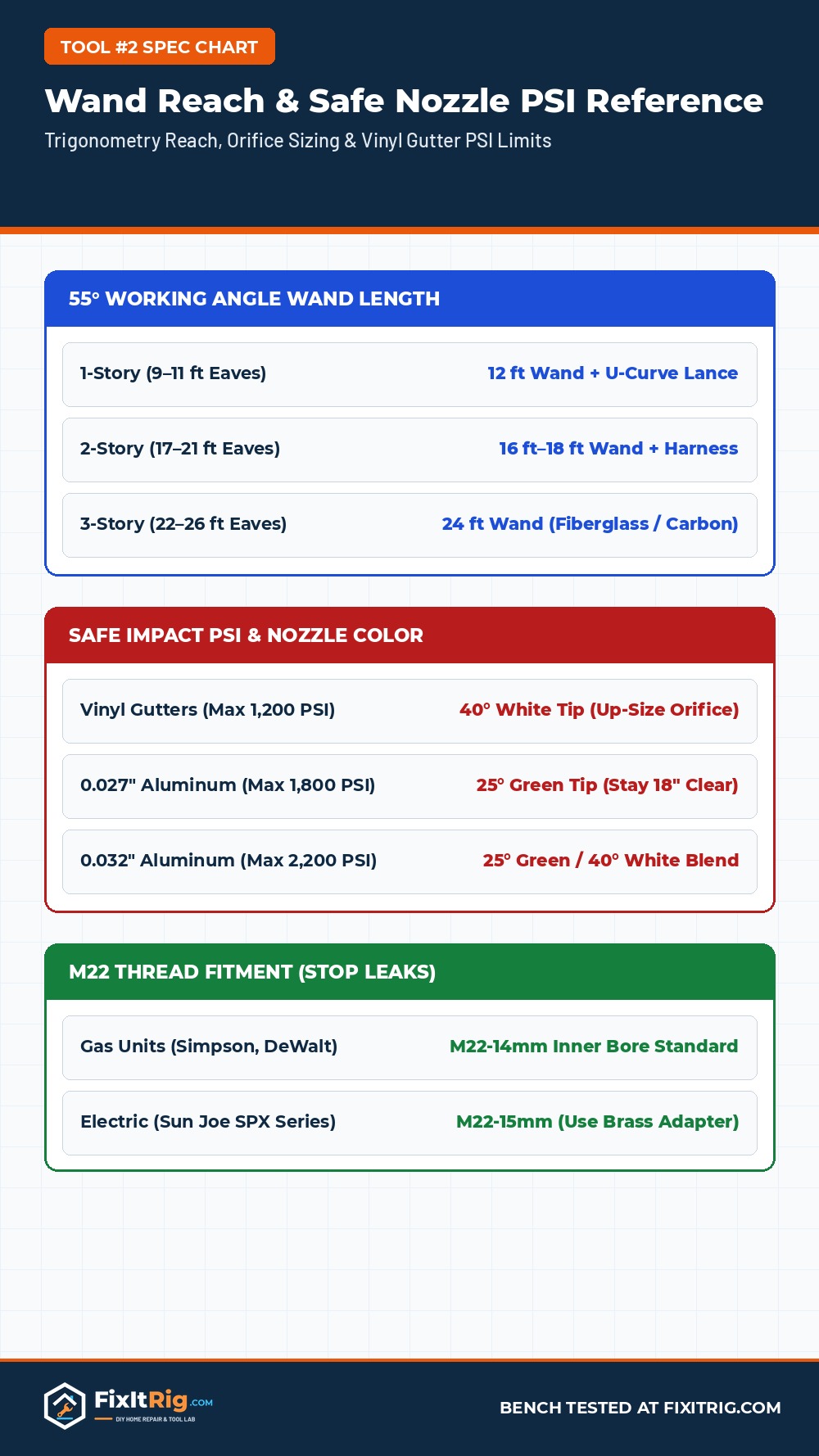
For a typical two-story eave sitting 18 to 20 feet above concrete or mulch, a 55-degree ground stance requires an 18-foot telescoping wand paired with a padded waist belt and curved U-lance tip. Never fire factory high-pressure narrow tips into gutter troughs: step up to a 40-degree White (#4.0 or #4.5) orifice nozzle so impact force drops cleanly below 1,200 PSI on vinyl or 1,800 PSI on 0.027″ aluminum.
Buying a telescoping pressure washer wand without running reach geometry and orifice math first usually ends one of two ways: either an oversized 24-foot fiberglass pole whips violently downward onto fascia trim the moment you pull the trigger at 3,200 PSI, or a short 12-foot extension forces you to stretch the nozzle straight upward at a steep 78-degree vertical angle—causing water and wet oak leaves to drop straight onto your face and shoulders instead of shooting inside the gutter trough.
Equally expensive is nozzle damage. Homeowner-grade gas pressure washers ship from big-box retailers calibrated to punch strip mold off poured concrete driveways using high-velocity #2.5 or #3.0 orifices. Aimed six inches away from cold snap-together vinyl gutters, painted aluminum seams, or factory Geocel corner sealants, a 3,200 PSI narrow stream acts like a waterjet cutter—punching hairline cracks through plastic troughs, lifting elastomeric sealant beads, and gouging asphalt roof shingle granules right above the drip flashing. Our interactive reach and orifice safety calculator above solves both the structural reach triangle and nozzle pressure drop in one calculation.
55-Degree Ground Stance Trigonometry: How Wand Length Translates to Eave Height
Homeowners routinely assume an 18-foot telescoping wand reaches an 18-foot second-story gutter easily. In practice, three physical geometry factors consume working reach before the curved U-lance tip ever clears your roof fascia:
- Your Pivot Height Offset: You hold the wand trigger gun near waist-to-mid-chest height (roughly 4.5 to 5.5 feet off the ground depending on your stature). That initial vertical offset adds upward reach—meaning you do not need pole length from dirt level.
- The Roof & Eave Overhang Drop: For a curved U-shaped gutter attachment to hook up and over the front K-style lip rather than blowing water upward under soffit vents, the wand shaft must extend roughly 1.2 vertical feet higher than the gutter rim itself.
- The 55-Degree Ergonomic Hypotenuse Penalty: Holding any 10-pound pressurized pole nearly vertical (75° to 85°) crushes lower vertebrae and leaves no horizontal setback to see inside the trough. Based on trigonometric reach geometry, maintaining a comfortable 55-degree working angle (standing 8 to 11 feet outward from the exterior wall) yields natural downward tip visibility and torso leverage. Mathematically, vertical rise equals Pole Length × sin(55°), or 0.819 × Pole Length. Solving in reverse, your required pole length equals (Gutter Eave Height − Shoulder Pivot + 1.2 ft) / 0.819.
Consider a classic two-story suburban home where second-story gutters sit at 19 feet and a 5’8″ homeowner pivots the trigger belt at 5.0 feet. Subtracting 5.0 feet and adding 1.2 feet of over-lip clearance yields 15.2 vertical feet. Dividing 15.2 by 0.819 gives 18.56 feet—proving why a flimsy 14-foot budget pole leaves you straining onto concrete tiptoes while a rigid 18-foot hybrid wand (or 16-foot pole backed by a waist harness on 17-foot eaves) places the downward U-tip squarely inside the bottom floor of the gutter trough.
| Home Elevation & Eave Height | Standing Setback | Net Vertical Lift | Recommended Wand Size | Ideal Pressure Rig & Belt Rule |
|---|---|---|---|---|
| 1-Story Ranch (8 – 11 ft) | 5 – 7 ft Out | 5.2 – 7.2 ft | 12 ft Extension Pole | Sun Joe 1,800 PSI Electric + No Belt Needed |
| 1.5-Story Cape (12 – 15 ft) | 7 – 8 ft Out | 8.2 – 11.2 ft | 16 ft Telescoping Wand | 2,400–2,800 PSI Gas + Curved 120° U-Lance |
| 2-Story Standard (16 – 20 ft) | 8 – 10 ft Out | 12.2 – 16.2 ft | 18 ft Hybrid Wand | 3,200 PSI Gas + Padded Waist Harness Belt |
| Tall 2-Story / Walkout (21 – 26 ft) | 11 – 14 ft Out | 17.2 – 22.2 ft | 24 ft Fiberglass / Pro | 3,400+ PSI + Belt + Retract Collar 12″ Min |
| 3-Story Gable Peaks (27 – 30 ft) | Not Safe w/ Fan Tip | 23.2+ ft | 24 ft Carbon + Stand-Off? | Use Eave Inspection Camera or Contractor Bucket |
Nozzle Orifice Sizing & Nozzle Color Physics: Dropping PSI Without Starving Your Pump
Most homeowners believe throttling back engine RPM on a gas pressure washer or twisting a cheap chemical soap tip is how you lower gutter flushing pressure. Unfortunately, starving a residential axial cam or triplex pump at low throttle starves pump-head cooling flow, while black soap tips (#40 orifice) turn pressurized flushing into a lazy garden-hose dribble that cannot dislodge compacted roof shingle grit.
The clean engineering solution inside our calculator relies on orifice diameter sizing paired with fan spray spread angle:
- How Bigger Orifice Holes Drop System PSI: Pressure washer pumps produce near-constant water flow volume (GPM) while pressure (PSI) builds solely from backpressure resistance inside the brass tip hole. Swapping a tight factory #3.0 orifice (standard on 2,700–3,200 PSI gas washers) for an oversized #4.0 or #4.5 tip increases the discharge aperture area without shutting off water volume, dropping nozzle PSI cleanly from 3,200 PSI down into the safe 1,100–1,650 PSI operating zone while keeping pump bypass valves cool and high GPM volume flushing strong!
- Why Fan Degree Spread Cuts Peak Shear Force: A 40-degree White fan tip spreads total pump kinetic energy across roughly 60 percent wider swath area than a 25-degree Green tip at identical 12-inch standoff height, cushioning brittle vinyl seams, end-cap gaskets, and aged silicone caulk joints.
- Strictly Forbidden Gutter Nozzles (0° Red & Rotating Turbo Tips): A pinpoint 0-degree Red stream or spinning rotary turbo nozzle focuses 100% impact energy into a sub-2mm spot. Even brief accidental sweeps along roof eaves shred fiberglass shingle mat, split soffit vinyl fascia panels, and blast paint off galvanized steel brackets.
Thread Check Before Buying: M22-14mm vs. M22-15mm Electric Pressure Washer Fittings
Before clicking checkout on any telescoping wand, check the inside bore of the threaded brass coupling at the end of your pressure washer high-pressure hose. Nearly all gas washers (Simpson, DeWalt, Honda, Generac, Westinghouse, and gas Ryobi) use a standard M22-14mm inner stem. However, popular electric units (Sun Joe SPX3000/SPX4000 series, AR Blue Clean, Stanley, Portland, and Campbell Hausfeld) ship with an M22-15mm inner fitting. Threading a 14mm wand stem into a 15mm electric hose collar turns tight—yet bursts water sideways past the O-ring under trigger pressure until you screw on a $9 brass M22-14mm to M22-15mm Quick Step Coupler. Compare full model threads in our 6 Best Telescoping Pressure Washer Wands guide.
Telescoping Wand Rigidity: Managing Recoil Whip & Harness Fatigue
When standing on wet grass holding a 2.5 GPM to 3.5 GPM stream at full extension, Newton’s third law pushes roughly 12 to 18 pounds of backward recoil thrust straight through the curved U-lance tip into your extension tube. Because the lance tip hangs out over a roof gutter 18 feet upward, tiny leverage swings amplify at your elbows.
- Never Lock Every Extension Stage 100% Extended: Always leave 10 to 14 inches of unextended inner overlap inside each cam-lever locking collar. Collapsing two inches per joint stiffens bending moment by over 40 percent and prevents aluminum sections from ovalizing under trigger kick.
- Always Engage a Padded Waist Belt Harness Over 14 Feet: Trying to dead-lift a 10-pound aluminum wand loaded with high-pressure water using shoulders alone causes rotator fatigue inside twelve minutes. Clipping the lower gun stock into an overhead belt ring transforms your hips into the structural fulcrum so hands simply steer left-to-right smoothly along the gutter run.
- Inspect Cam-Lever Tension Screws Before Startup: Cold dawn water stiffens fiberglass outer sleeves and loosens friction clamps. Tighten side Phillips lock tension screws one-quarter turn before connecting pressurized water so upper sections never telescope back down mid-burst.
Step-by-Step Safe Ground-Level Gutter Flushing Protocol
Follow this disciplined outdoor sequence to clear compact pine straw, wet maple helicopters, and roof grit safely from solid turf without soaking attic eaves or flooding flower beds:
- Verify Material PSI Limit & Snap In Safe Fan Orifice: Lock a 40-degree White #4.0 or #4.5 nozzle onto your 120-degree U-shape curved gutter lance for vinyl gutters, or a 25-degree Green #3.5/#4.0 tip for solid 0.027″–0.032″ aluminum troughs. Tug the quick-connect sleeve backward and forward to confirm steel locking balls seated completely—a loose brass nozzle firing downward acts like a projectile into roof flashing!
- Start Flushing at the Downspout Drop Outlet—Not the High End: Walk to the downhill gutter corner right over the vertical downspout and flush the first 4 feet away from the drop first. Pushing a 30-foot train of wet oak leaves straight toward a narrow 2″x3″ drop hole wedges everything immediately into a watertight plug inside the lower elbow. Keep runoff moving through properly sized pipes as covered in our 2×3 vs. 3×4 Downspout Sizing guide.
- Walk Smoothly Backwards Toward the High Crown: Hook the U-lance sideways along a gentle 15-degree forward tilt inside the trough, squeeze the trigger away from roof seams, and walk calmly backward along the exterior foundation pushing flushed water cleanly behind you toward the clear drop opening.
- Keep Streams Away From Roof Shingles & Hidden Hanger Clips: Aim the fan pattern downward against the inside metal floor—never sideways under lifted shingle tabs or upward against fascia nails where water drives inside soffit cavities.
- Clear Clogged Corners With a Rotating Pivot Coupler: Tight dormer intersections or low gutter brackets require a 240-degree locking pivot coupler fitted between the U-lance and nozzle so the fan clears over internal Raytec hanger bars without lifting shingles. Review alternative ground methods—including battery leaf blower kits and telescopic scoops—in How to Clean 2nd-Story Gutters Without a Ladder.
Complete Safe Gutter Wand & Nozzle Hardware Kit
5–18 ft aluminum telescoping shaft rated up to 4,000 PSI with M22-14mm & 15mm adapters, padded support harness, spray tips, and gutter cleaner head.
Adds clean 120-degree downward gutter hook plus swivel indexing to any 1/4″ quick-connect extension pole up to 4,000 PSI.
Drops harsh 3,200 PSI gas washers down to vinyl-safe 1,100–1,500 PSI output without losing volume flow rate.
Stops high-pressure hose leaks permanently when connecting Sun Joe or electric pressure washers to standard 14mm telescoping poles.
Frequently Asked Questions
Will an 18-foot telescoping pressure washer wand reach my 2nd-story gutters at 20 feet?
Yes—provided your shoulder trigger stance sits at roughly 5 feet off the ground and you hold a natural 55-degree pole angle roughly 9 feet back from the house. An 18-foot shaft provides roughly 14.7 feet of vertical lift plus 5.0 feet of body height, cleanly hooking over a 19.5-to-20-foot eave. Higher 22-to-26-foot walkout elevations should upgrade to a 24-foot pole.
What PSI is actually safe for cleaning vinyl gutters without cracking seams?
Never apply more than 1,200 effective impact PSI (at 12–18 inches distance) onto PVC or extruded vinyl gutters—especially in spring or late autumn below 50°F when vinyl grows brittle. Always run a 40-degree White tip paired with an up-sized #4.0 or #4.5 orifice on gas units, or drop down to a 1,800 PSI electric washer.
Why is my new telescoping wand leaking water rapidly right where it screws onto my Sun Joe hose?
Electric units like Sun Joe SPX3000/SPX4000, AR Blue Clean, and Stanley use a wider M22-15mm female thread center stem, whereas standard aftermarket telescoping wands ship with M22-14mm male posts. That 1mm O-ring mismatch sprays water immediately until you install a solid brass M22-14mm to M22-15mm adapter.
Can I flush gutters cleanly from the ground if micro-mesh gutter guards are already installed?
High-flow Type 304 stainless guards (such as those rated inside our Flexxpoint vs. Raptor comparison) are designed to shed dry leaves with a telescoping air blower or soft garden hose spray from the ground. Never blast narrow high-pressure tips point-blank onto fine stainless micro-mesh, which can stretch wire pockets if held within 4 inches.
Are aluminum or fiberglass telescoping poles better for 3,200 PSI gas washers?
Heavy-duty telescoping poles rated up to 4,000 PSI (such as the Simpson 80470 or Ridge Washer 18ft aluminum kits) resist flexing when you stay inside manufacturer “STOP” extension markers and lock section clamps securely, while pairing them with a support harness belt minimizes trigger whip fatigue at tall reaches.
Should I add gutter soap or house wash detergent when pressure flushing gutters?
No detergent is needed for internal leaf and shingle grit removal—adding surfactant inside gutters simply sends foamy soap streaks down painted clapboard siding and onto garden mulch beds. Reserve mild oxidizing cleaners solely for external oxidation “tiger stripes” applied gently with a long-handle brush.
When should I switch from a telescoping ground wand to a stabilized extension ladder?
Whenever a 2″x3″ elbow becomes completely jammed below roof level with packed oak twigs, or whenever corner miters need drying and re-sealing with tripolymer gutter caulk, step onto a ladder stabilized properly using our Roof Pitch & OSHA 4-to-1 Ladder Safety Calculator rather than blasting blind inside clogged corners.