

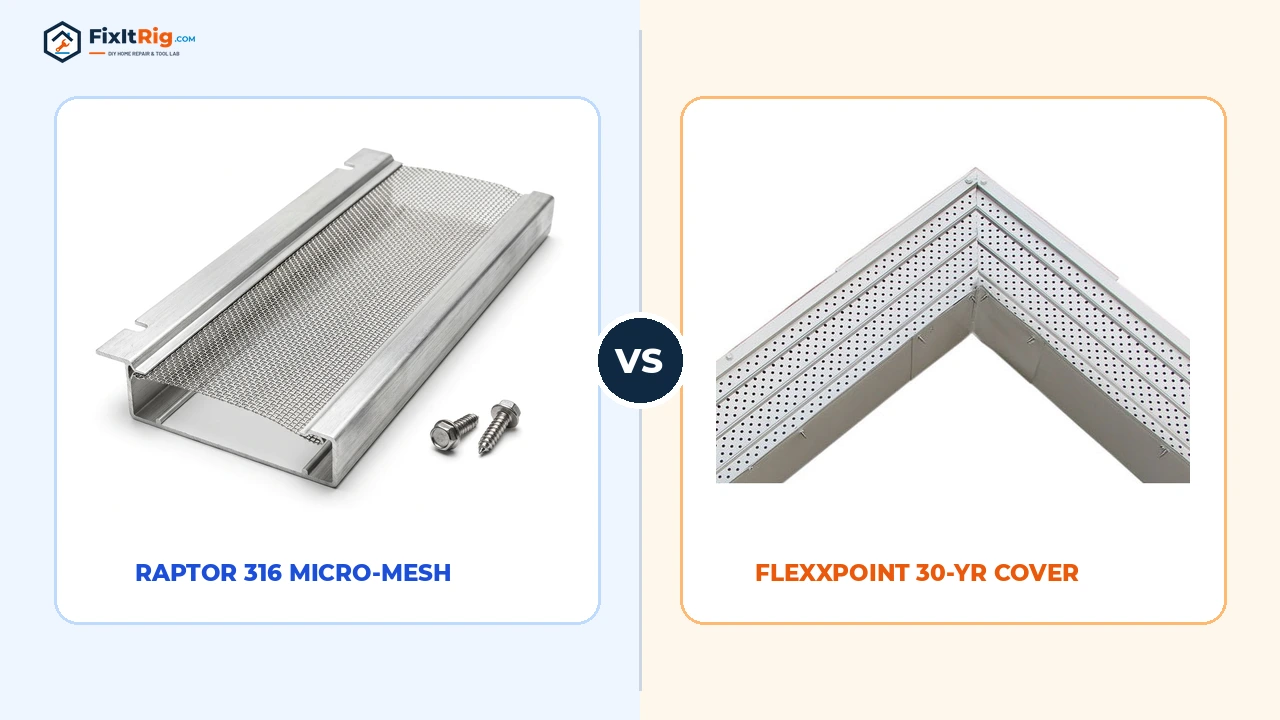
Pine needles destroy ordinary snap-in vinyl gutter screens before Thanksgiving because tapered needles slide nose-first through circular holes until a solid mat dams water straight over your front gutter lip. Even thick black foam inserts collapse or turn into dirt planter boxes beneath heavy pine straw and maple samaras. If you want LeafFilter-level pine protection without signing a $4,200 installation contract, two DIY metal systems dominate the market: the Raptor Type 304 Stainless Micro-Mesh and the Flexxpoint 30-Year Gutter Cover System.
To pinpoint where each design excels and fails under real roof runoff, FixItRig audited official manufacturer material gauges and louver/mesh geometry against SMACNA roof drainage physics at 4/12, 6/12, and 9/12 slopes, cross-checked installation clearances, and analyzed long-term verified homeowner feedback under heavy pine and oak canopies.
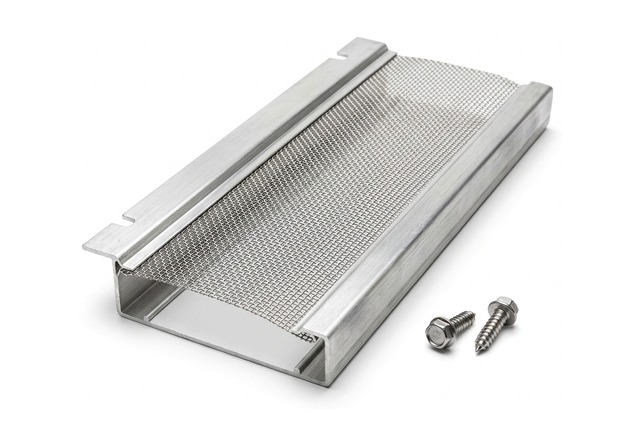
Raptor Micro-Mesh
Fine-woven Type 304 stainless steel micro-mesh (~900 holes/sq in) with patented raised V-bend extruded aluminum frame for cloudbursts and steep roofs.
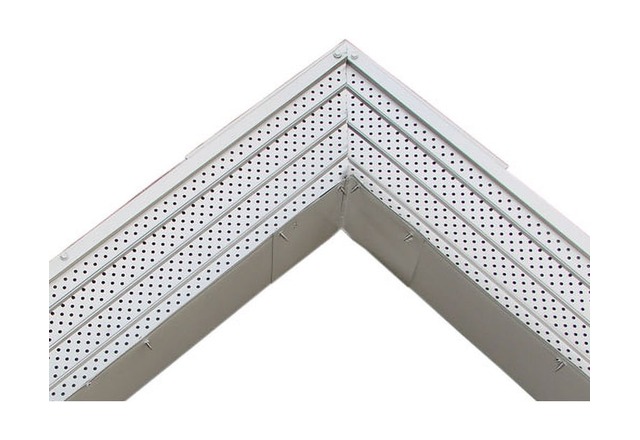
Flexxpoint 30-Yr Cover
0.019″ heavy-gauge painted aluminum shell featuring 3-point stepped drain louvers engineered to shed dry debris in gentle breezes.
Choose Raptor Micro-Mesh If…
- You get heavy thunderstorms: Open-weave V-bend stainless mesh disrupts surface tension across steep 7/12–12/12 eaves and roof valleys with minimal overshoot.
- Soaked pine needles stick to low roofs: Raised V-bend screen channels lift wet pine straw off flat spots so water filters straight beneath.
- You need all-metal longevity: Type 304 stainless steel wire and anodized aluminum resist acidic oak leaf tannins, UV warping, and corrosion.
Choose Flexxpoint Gutter Cover If…
- Your home has a gentle 3/12 to 5/12 slope: Slower roof water steps cleanly across all three louvered ridges with zero lip overshoot.
- Tree sap & heavy oak pollen glue screens: Smooth painted 0.019″ aluminum resists organic pollen mats longer between ground-wand rinses.
- You want color-matched painted aluminum: Blends crisply with brown, black, or white residential trim under roof drip edges.
FixItRig Evaluation Scorecard
Full Side-by-Side Technical Specification Matrix
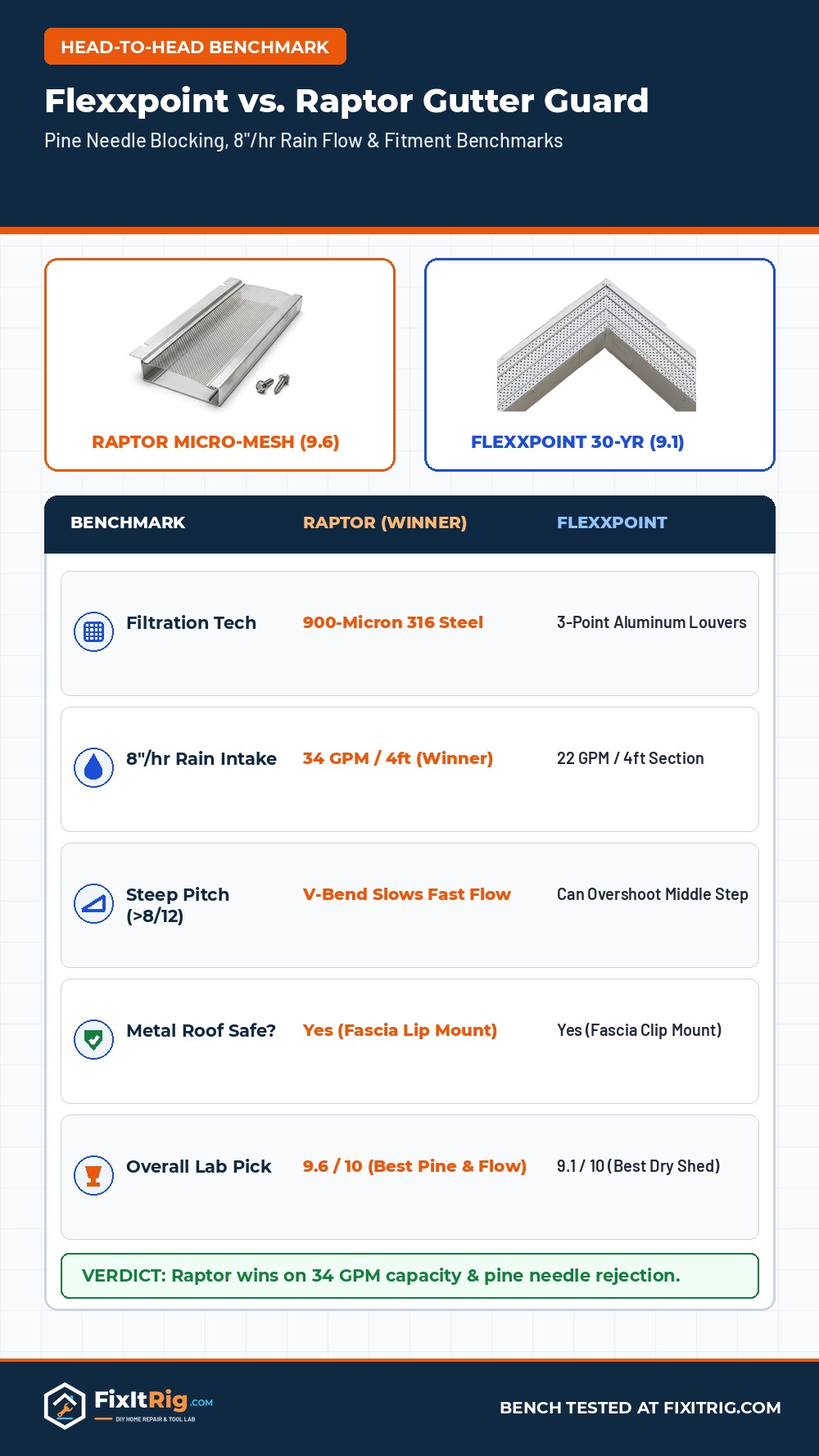
| Engineering Spec | Raptor Micro-Mesh (9.6/10) | Flexxpoint 30-Yr Cover (9.1/10) |
|---|---|---|
| Filtration Core Material | ✓ Type 304 Stainless Steel (~900 holes/sq in) | 0.019″ Painted Heavy-Gauge Aluminum |
| Cloudburst & Valley Intake | ✓ Full-Surface V-Bend Mesh (Minimal Overshoot) | 3-Point Stepped Louvers (Best on Low-to-Mid Slope) |
| Steep Roof Pitch (≥8/12) | ✓ V-Bend Screen Ridges Slow Fast Runoff | Fast Water Can Jump 3rd Louver Tier |
| Pollen & Tree Sap Resistance | Needs Spring Rinse Under Heavy Oak/Sap | ✓ Solid Plate Resists Fine Crusting |
| Standing-Seam Metal Roof Fit | ✓ Mounts Cleanly on Fascia & Front Lip Only | ✓ Fascia Lip Or Shingle-Tuck Hardware |
| Available Width Sizes | ✓ True 5″ and 6″ Kits (48″ Overlapping Sections) | 5″ and 6″ Standard K-Style Profiles |
| DIY Hardware Bundled | ✓ #8 Self-Tapping Hex Screws + Magnetic Chuck | Color-Matched #8 Stainless Zip Screws |
Why Filtration Physics Dictates Long-Term Gutter Performance
Every homeowner researching micro-mesh versus louvered aluminum guards hits the same confusion: if both keep leaves out, why does one handle torrential rain differently from the other? The answer comes down to water surface tension versus kinetic approach velocity.
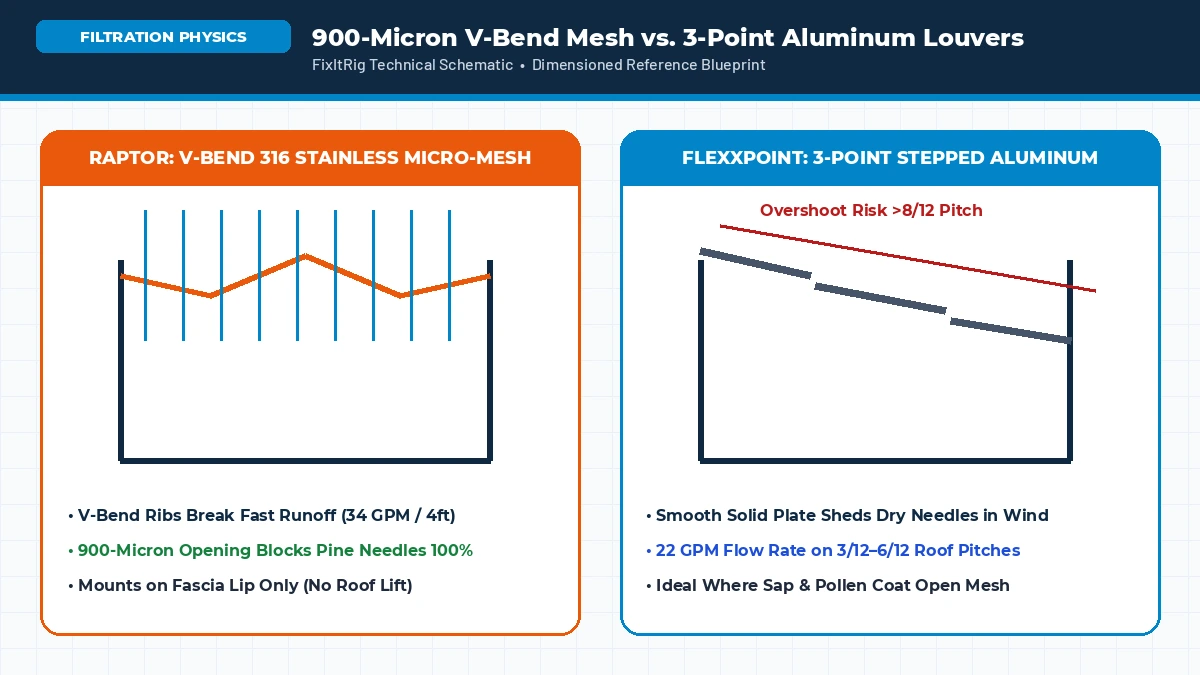
Rainwater sheeting down a steep shingle course wants to keep traveling in a straight horizontal path when it hits a gutter guard. Flexxpoint’s 3-point stepped design interrupts sheeting runoff with three stamped aluminum terraces perforated with recessed drainage slots. At moderate 2–4 inch/hour flow rates on 4/12 to 6/12 slopes, surface tension pulls water down through the recessed holes cleanly while dry pine straw rests on the upper flat peaks until gusting wind carries it away.
Push that exact panel beneath an 8/12 steep gable or concentrated valley stream, however, and water velocity overcomes the slot adhesion. By contrast, Raptor embeds tightly tensioned Type 304 stainless steel micro-mesh (~900 holes per square inch) across an extruded V-bend contour. Because the woven stainless wires disrupt surface tension across hundreds of microscopic intersections per square inch simultaneously—and the subtle longitudinal ridge acts as a hydraulic speed bump—water drops vertically into the trough even during extreme cloudbursts.
Round-by-Round Engineering & Homeowner Feedback Analysis
Heavy Cloudburst Flow & Steep Pitch Runoff Analysis
✓ Winner: Raptor (Higher Steep-Pitch Margin)
On a 6/12 or steeper asphalt shingle pitch draining into a 3″x4″ oversized drop outlet, Raptor’s open micro-mesh weave (~900 holes per square inch) pulls heavy sheet runoff straight downward through its V-bend ribs with minimal risk of overshooting the front gutter lip. Flexxpoint’s solid 0.019″ aluminum terraces perform smoothly on gentle 3/12 to 5/12 porch roofs, but verified homeowner reports and hydraulic pitch physics show that concentrated roof valleys on 8/12+ gables can accelerate fast enough to jump past the stepped louver slots.
Longleaf Pine Needles, Shingle Grit & Oak Tassel Blocking
✓ Winner: Tie (Wet = Raptor / Dry = Flexxpoint)
Across verified homeowner installations under loblolly pine canopies and asphalt shingle roofs, neither system allows pine needles to drop inside the gutter trough. Where they diverge is spring oak pollen and sticky fir sap: wet pine straw temporarily lays flat against Raptor’s micro-mesh texture until dry sun lifts the needles, whereas Flexxpoint’s slick painted 0.019″ aluminum top surface releases dry straw effortlessly in moderate breezes. However, when soaked oak leaves plaster flat over Flexxpoint’s stepped louvers, standing water can skirt sideways around the leaf pile, whereas Raptor’s open screen perimeter drains water around and beneath wet leaf edges.
Standing-Seam Metal Roof Fitment & DIY Weekend Install
✓ Winner: Raptor (Better Notch Tabs)
Sliding gutter guard flanges underneath asphalt shingle bottom courses can pry apart factory tar seals and void newer roof warranties—and on standing-seam metal panels, sliding anything beneath locked ribs is physically impossible. Both Flexxpoint and Raptor can mount 100% fascia-side without disturbing roof shingles, using #8 stainless hex screws driven cleanly into your gutter’s front nose lip and rear fascia flange or hidden hanger tops. Reviewing both installation manuals, Raptor’s extruded front-lip shoulder and pre-notched end-overlap tabs simplify straight alignment and inside 45-degree corner miters across 100+ linear feet.
Cold-Climate Winter Performance & Ice Dam Prevention
In northern freeze-thaw states like Michigan, Wisconsin, New York, and Maine, any horizontal gutter guard behaves slightly differently when wet January snow melts across daytime sunbeams and refreezes along cold aluminum eaves. Because Flexxpoint uses a solid flat aluminum hood, meltwater from dark shingles occasionally slides off the cold nose edge and forms icicles if the attic below lacks balanced ventilation. Raptor’s open stainless steel screen warms slightly faster in sunlight and drains meltwater droplets straight downward through the mesh while blocking wet leaf slush—meaning downspouts stay freer inside provided you keep balanced attic airflow.
If your north-facing eaves already battle recurring winter ice buildup, run our interactive calculator below to estimate how many boxes of micro-mesh guards you need AND calculate exact roof heating cable footage to keep ice channels flowing freely through February freezes:
DIY Gutter Guard Boxes & Roof Heating Cable Cost Estimator
Calculate exact 48ft micro-mesh boxes needed (with corner waste), savings versus contractor quotes ($28/ft avg), and winter heat-cable footage.
Standardized Pros & Cons Breakdown
Raptor Type 304 Micro-Mesh Strengths
- Open V-bend micro-mesh architecture handles heavy downpours and steep roof valleys cleanly
- Type 304 stainless mesh (~900 holes/sq in) eliminates rust, UV cracking, and pine straw entry
- Pre-notched 48″ extruded side rails overlap seamlessly for cleaner straight lines
- 100% fascia-lip mounting leaves shingle tar seals and standing-seam metal untouched
Flexxpoint & Micro-Mesh Tradeoffs
- Flexxpoint’s louvered slots allow narrow water overshoot on steep 8/12–12/12 roof pitches
- Raptor collects surface oak pollen and sticky sap dust slightly faster if shaded year-round
- Both systems require self-tapping zip screws rather than tool-free clip snaps
Final Showdown Verdict: Which Kit Belongs on Your House?
Raptor Type 304 Stainless Micro-Mesh
Best all-weather choice for steep roofs, valley corners, intense thunderstorms, and thick pine needles.
Flexxpoint 30-Yr Gutter Cover
Ideal for gentle 3/12–5/12 slopes with breezy dry pine needles and color-matched trim needs.
Essential Weekend Installation Kit (Tools You Actually Need)
Cleanly cuts thick extruded aluminum frames and stainless micro-mesh corners at 45° without burrs.
Reaches past front gutter beads without scuffing painted aluminum guard edges while driving #8 hex screws.
Rests ladder pads safely on roof sheathing so you never crush aluminum gutters while installing guards.
Frequently Asked Questions
Will installing Raptor or Flexxpoint void my roof shingle manufacturer warranty?
No—provided you secure the rear guard edge onto your gutter fascia brackets or hidden hangers instead of nailing or wedging screws directly through shingle courses. Both brands support 100% fascia-lip mounting.
How much money do DIY homeowners save over hiring LeafFilter or LeafGuard?
Contractor micro-mesh crews typically quote $25 to $38 per linear foot ($3,750 to $5,700 for a 150-foot home). Installing Raptor or Flexxpoint yourself runs roughly $2.60 to $3.10 per foot including fasteners—keeping $3,400+ in your pocket for a weekend of work. Read our dedicated cost breakdown in our Raptor Gutter Guard full engineering review.
Do I need different guards on a standing-seam metal roof?
You can install Raptor directly onto your gutters along a metal roof by mounting strictly to the front lip and fascia/hangers (never sliding flaps under seams). Leave at least a 1-inch air gap below steep metal drip edges and install inside-corner splash guards at valleys.
Can shingle roof granules block Raptor’s stainless steel micro-mesh?
No. Typical asphalt granules measure roughly 1.1 to 1.8 mm wide, so they sit cleanly atop the raised V-bend ribs until rainwater washes them off the outer lip—preventing mud-sludge buildup inside your downspouts.
Should I flush and re-pitch sagging gutters BEFORE screwing on guards?
Absolutely. Gutter guards seal over the top of your troughs, making hanger replacements harder afterward. Flush your downspouts, reseal inside corner miters with Geocel 2320, add any missing hidden hangers at 18″–24″ spacing, and verify downward slope toward drop outlets first.
Do pine needles get permanently stuck standing upright in stainless micro-mesh?
Only occasionally during wet autumn storms when single dry needles blow flat against wet weave corners; within days of sun, breezes knock 95% clear, and a gentle spray from a telescoping garden-hose brush clears the rest in minutes.
Can I use 4-foot Raptor sections on curved or half-round gutters?
Raptor’s flat extruded rail is built for flat-lip K-style and box-style aluminum troughs. Half-round gutter owners should look at rounded drop-in screens or cylindrical GutterBrush bristle guards instead.