
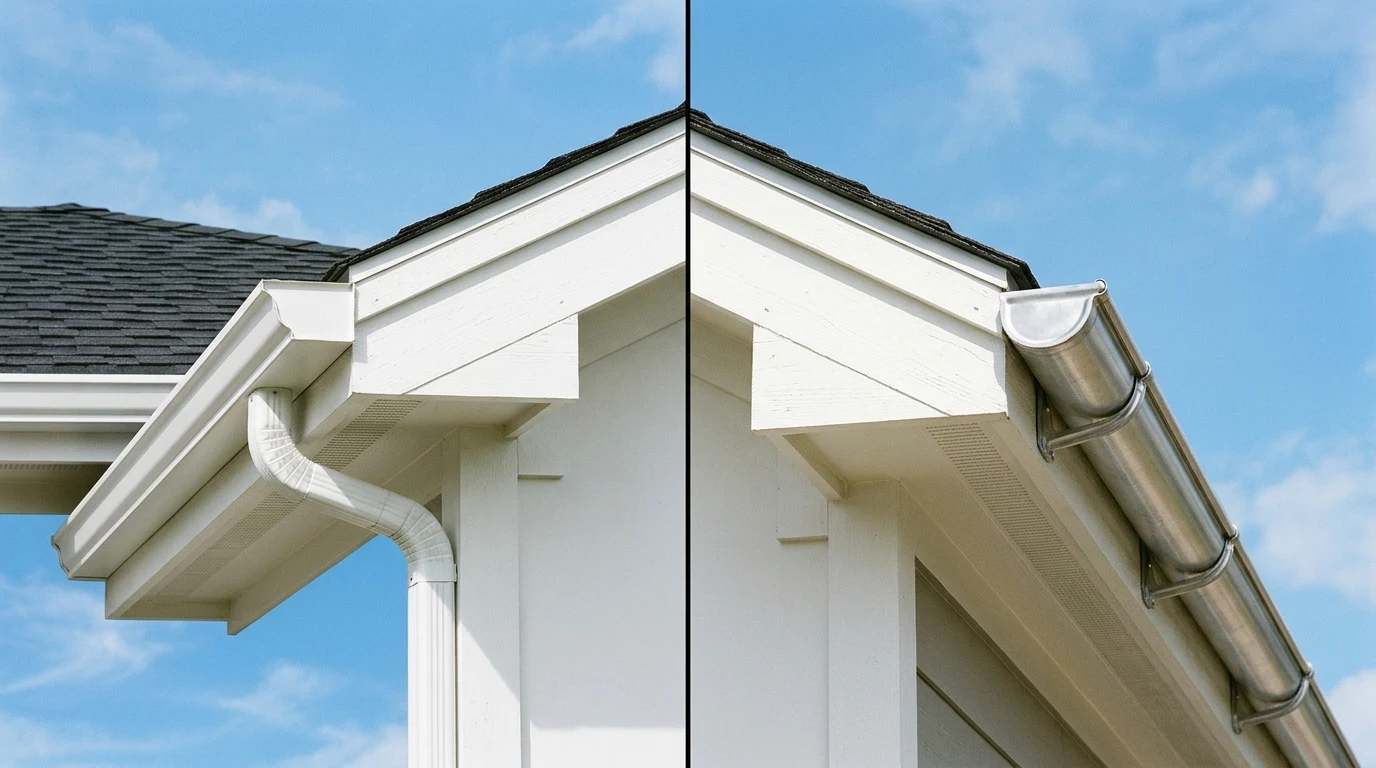
Choosing between K-style and half-round gutters is rarely just an exterior curb-appeal decision. Because residential gutter capacity depends on cross-sectional geometry, hanger mechanics, and metal thickness, picking the wrong profile for your roof pitch and winter snow load leads directly to mid-span sagging, overflowing inside corners, and mismatched gutter guards.
To clarify exactly how each profile performs in hydraulic capacity, structural bracket strength, and total DIY material cost, FixItRig audited Sheet Metal and Air Conditioning Contractors’ National Association (SMACNA) sizing geometry, RHEINZINK/Copper Development Association (CDA) hanger spacing rules, 0.027″ versus 0.032″ aluminum coil specifications, and sectional material pricing across aluminum, galvanized steel, and copper—plus we included a 4-step visual DIY hanging guide right before the FAQs.
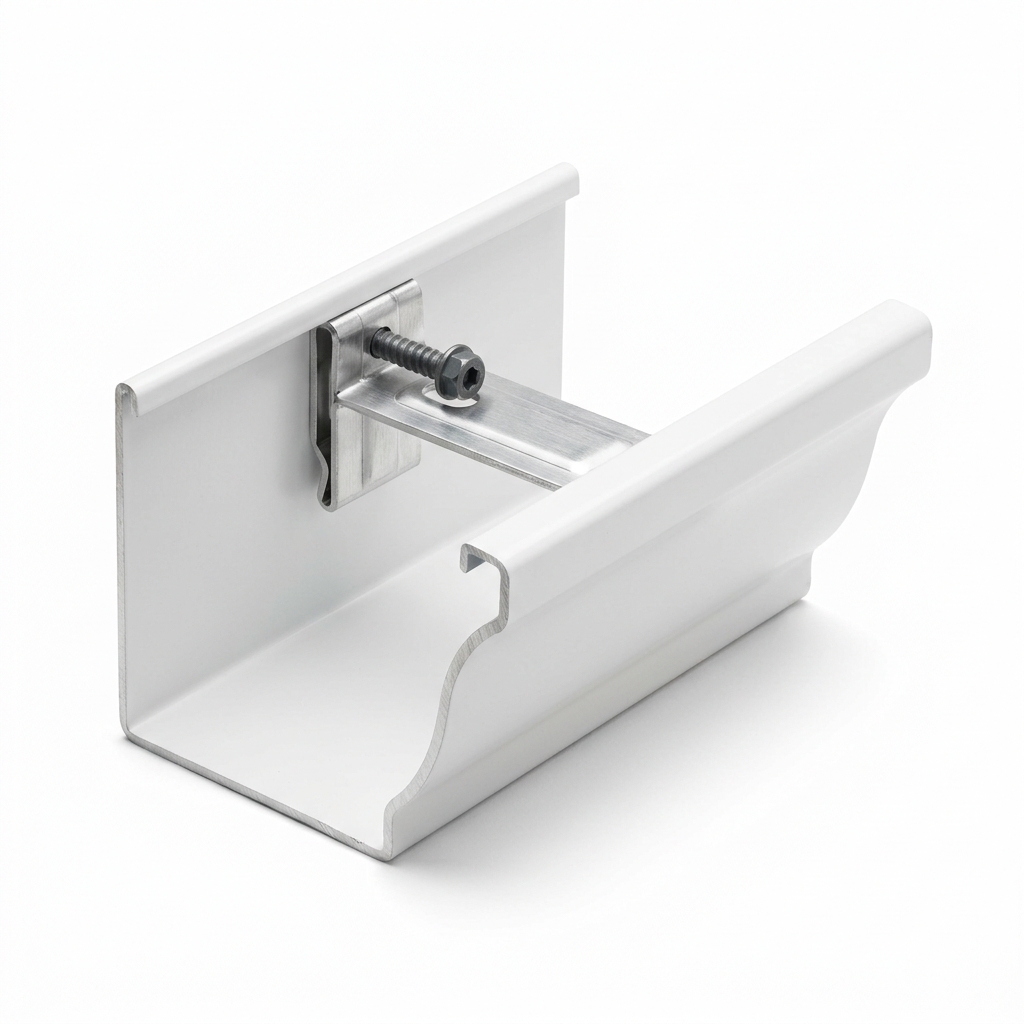
K-Style Gutters (5″ & 6″)
Flat-back ogee aluminum or steel trough offering ~15%–20% higher cross-sectional volume than half-round and flush fascia mounting with hidden internal hangers.
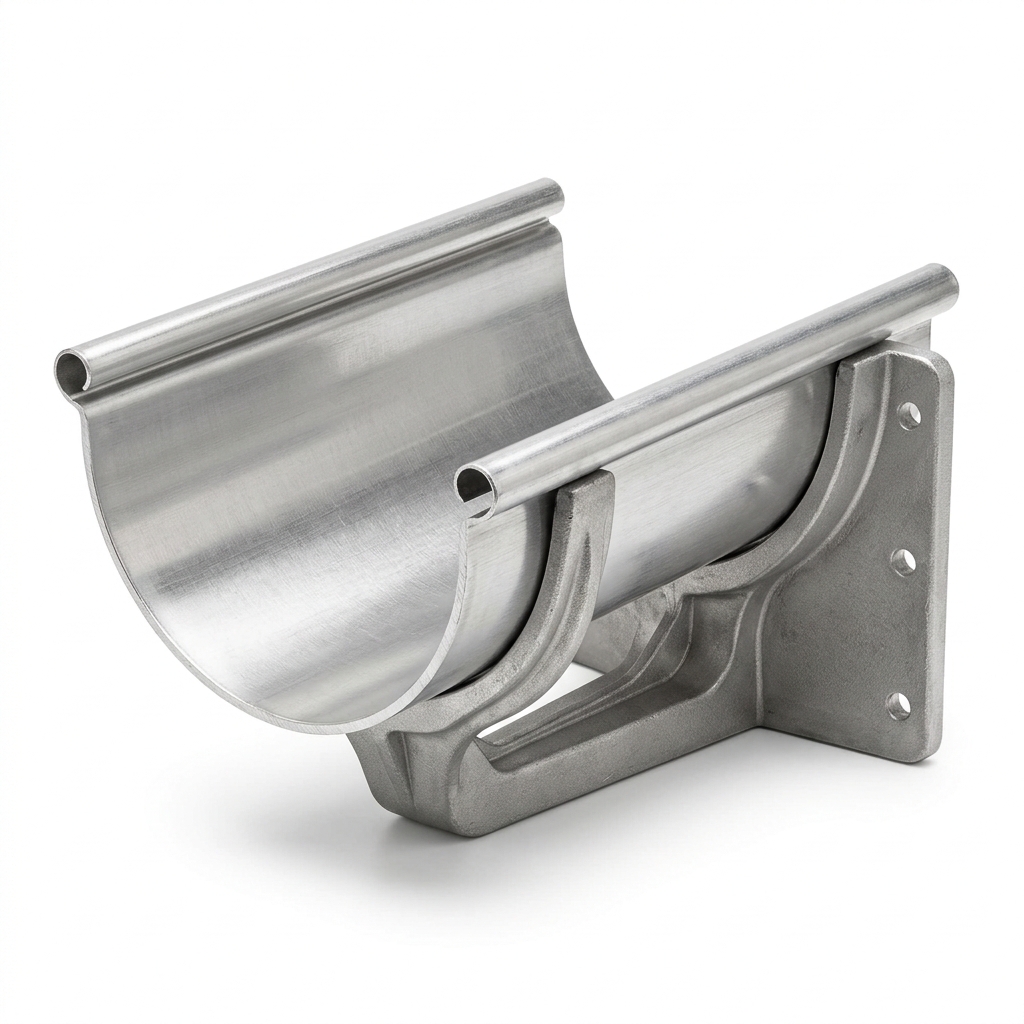
Half-Round Gutters (5″ & 6″)
Smooth semicircular trough that sheds shingle grit naturally with zero 90-degree corners, favored on historic brick, slate, and standing-seam metal roofs.
Choose K-Style Gutters If…
- You want maximum storm capacity per inch of width: Flat bottoms and vertical back walls hold ~15%–20% more water volume than half-round gutters of the same nominal size (~2.0 gal/ft in 6″ K-style).
- You are budgeting a cost-effective DIY install: Sectional 10ft K-style aluminum lengths, slip joints, hidden hangers, and corners are stocked in every home center at ~$3.50–$7.00/ft for the trough.
- You plan to add DIY stainless micro-mesh guards: Flat front rims and straight backs accept screw-on guards like Raptor and EasyOn cleanly without custom brackets.
Choose Half-Round Gutters If…
- You own a historic, slate, cedar, or standing-seam roof: Architectural curved lines complement pre-1950 masonry, Craftsman bungalows, and European copper/zinc exteriors.
- Self-cleaning debris flushing is a top priority: Smooth semicircular floors eliminate sharp 90-degree interior corners where wet oak leaf silt and asphalt grit stagnate.
- You will step up to 6-inch sizing or tighter drops: Sizing up from 5″ K-style to 6″ half-round restores drainage margin while keeping decorative smooth-flow symmetry.
Editorial Comparison Summary
How We Scored These Gutter Profiles: Scores reflect FixItRig’s weighted editorial rubric—Cross-Sectional Water Capacity (30%), Bracket Rigidity & Snow-Load Support (25%), DIY Cost & Parts Availability (20%), Guard & Downspout Compatibility (15%), and Self-Cleaning Hydraulic Flow (10%)—derived from SMACNA geometry, manufacturer bracket specs, and published material pricing rather than physical lab testing.
Full Side-by-Side Technical Specification Matrix
| Engineering Spec | K-Style Gutters (9.4/10) | Half-Round Gutters (8.8/10) |
|---|---|---|
| Trough Cross-Section Geometry | ✓ Flat Back, Flat Bottom, Crown Ogee Front | True Semicircle w/ Rolled Front/Rear Beads |
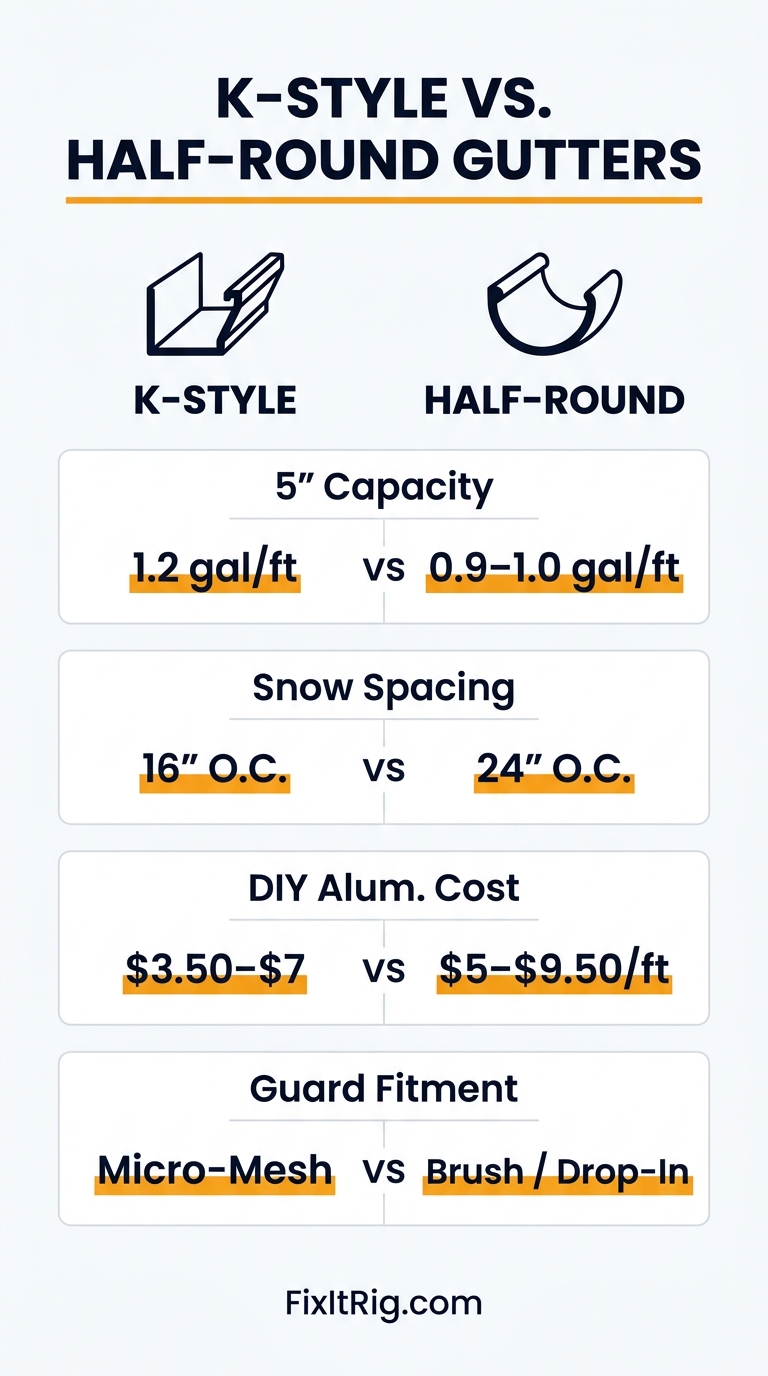
| 5-Inch Static Water Volume | ✓ ~1.2 gal / linear ft (~1,200 sq ft roof baseline) | ~0.9 – 1.0 gal / linear ft (~900 sq ft baseline) |
| 6-Inch Static Water Volume | ✓ ~2.0 gal / linear ft (~67% step-up over 5″) | Matches ~5″ K-Style Roof Workload (~15–20% less than 6″ K) |
| Sediment & Leaf Flushing | 90° Bottom Corners Hold Wet Grit Longer | ✓ Smooth Curve Flushes Sediment Cleaner |
| Hanger Spacing (Std / Snow) | ✓ Hidden Hangers @ 24″ O.C. (16″ O.C. Snow/Ice) | Fascia/Circle Brackets @ 30″–32″ O.C. (24″ O.C. Snow) |
| DIY Material Cost (Alum / Steel) | ✓ ~$3.50–$7.00 Alum / ~$6–$11 Steel per ft | ~$5.00–$9.50 Alum / ~$8–$15 Steel per ft (+20–40% hardware) |
| Downspout & Guard Pairing | ✓ 2″x3″ / 3″x4″ Rect + Micro-Mesh Rails | 3″ / 4″ Round Pipes, Chains + Brush / Drop-In Guards |
Water Volume vs. Hydraulic Self-Cleaning Physics (5″ vs. 6″)
When comparing equal nominal widths, geometry gives K-style gutters roughly 15% to 20% more internal cross-sectional area than half-round gutters. A semicircular half-round channel curves inward along both bottom quadrants, whereas a K-style channel drops straight down from a flat fascia rear wall across a wide flat floor—maximizing carrying capacity per inch of mouth width.
- 5-Inch Profile Comparison: A standard 5-inch K-style gutter holds roughly 1.2 gallons per linear foot (commonly sized for around 1,200 sq ft of roof drainage per downspout under baseline rainfall), compared with roughly 0.9 to 1.0 gallons per linear foot (~900 sq ft baseline) for a 5-inch half-round trough.
- 6-Inch Upgrade Rule: Stepping up to a 6-inch K-style profile boosts carrying volume to roughly 2.0 gallons per linear foot—about a 67% jump in storage buffer for steep gables and concentrated roof valleys. Because half-round holds proportionally less per nominal inch, contractors following SMACNA sizing practice routinely specify a 6-inch half-round gutter whenever a home would otherwise call for a baseline 5-inch K-style system, or add extra downspout drops.
- Where Half-Round Wins Hydraulically: Static volume does not tell the whole flow story. Because half-round troughs eliminate 90-degree interior bottom bends, low-volume rain washes asphalt shingle sand and decomposed oak grit cleanly toward the drop outlet instead of leaving wet sludge ridges along the corners. Note also SMACNA’s length rule: keep continuous gutter runs capped at 50 feet maximum between high points or expansion joints, pitched steadily at 1/4 inch per 10 feet toward downspouts.
Bracket Strength, 0.027″ vs. 0.032″ Gauge & Snow-Zone Spacing
Under wet autumn leaf loads or northern ice dams, a gutter is only as strong as the aluminum gauge and the brackets anchoring it to fascia boards:
- 0.027″ vs. 0.032″ Aluminum Coil Thickness: Standard builder-grade seamless and sectional gutters roll-form from 0.027-inch aluminum, which dents more easily under ladder rails and can tear around screw holes if hangers sit too far apart in snow belts. Stepping up to heavy-duty 0.032-inch aluminum increases wall stiffness noticeably against ice heave and accidental ladder pressure.
- K-Style Internal Hidden Hangers (e.g., Raytec Hangtite / Hangfast): Because K-style gutters press a flat rear wall flush against the fascia board, modern screw-in hidden hangers span completely inside the trough—hooking under the front folded hem and clipping onto the back lip. This locks the gutter into a rigid closed box beam. Standard spacing is 24 inches on center (O.C.), tightened to 16 inches O.C. in heavy snow and ice zones.
- Half-Round Cradle Brackets (e.g., Berger #10/#15, Bar Hangers, Circle & Shank): Semicircular gutters lack a flat rear wall and rely entirely on exterior wrap cradles or heavy bar hangers to maintain their arc. Standard architectural specs (RHEINZINK/CDA) allow 30 to 32 inches O.C. spacing in mild climates using sturdy cast or heavy-strap brackets, tightened to 24 inches O.C. in snow regions—never stretch thin 0.027-inch half-round aluminum to 32 inches under heavy snow or the span can ripple between cradles.
Critical Fastener Warning: Never Reuse Old Spike-and-Ferrule Nails on Any Profile
Older homes built before the mid-1990s often rely on 7-inch aluminum spikes driven through hollow ferrules into fascia boards. Over 10 to 15 freeze-thaw seasons, smooth spike shanks work loose out of damp fascia wood. Whether you repair an existing K-style run or hang new sectional lengths, pull failing spikes completely and anchor structural #10 hex-head screw-in hangers straight into solid rafter tails.
DIY Sectional Material Cost Breakdown (Aluminum, Steel & Copper)
Unless you hire a contractor with a truck-mounted seamless roll-former, DIY homeowners install 10-foot or 20-foot sectional lengths joined with slip connectors and tripolymer gutter sealant. Comparing typical residential market pricing for trough channels reveals why K-style dominates DIY budgets:
- Aluminum Gutters: K-style DIY trough materials typically run $3.50 to $7.00 per linear foot, whereas half-round aluminum runs $5.00 to $9.50 per linear foot due to lower retail volume and rolled-edge tooling.
- Galvanized / Galvalume Steel: Heavy-duty K-style steel averages $6.00 to $11.00 per linear foot compared with $8.00 to $15.00 per linear foot for half-round steel—offering rigid snow strength at the cost of heavier lifting and raw-cut edge sealing.
- 16-oz / 20-oz Solid Copper: Specialty copper K-style channels run roughly $18.00 to $30.00 per linear foot, while classic half-round copper climbs to $22.00 to $42.00+ per linear foot (and traditionally requires soldering joints rather than standard caulked slip couplings).
- Hidden Bracket & Accessory Markup: Remember that linear trough pricing excludes corners, end caps, drop outlets, and hangers. Because decorative half-round fascia cradles, circle/shank assemblies, and round downspout fittings carry specialty-profile pricing, expect hanging hardware on a half-round project to add roughly 20% to 40% more to your accessory bill than K-style hidden hangers.
Gutter Guard, Downspout & Rain Chain Compatibility
Before committing to either trough shape, check which downstream accessories actually bolt onto it:
- Leaf Protection Limits on Half-Round: Nearly all mainstream DIY stainless steel micro-mesh gutter guards (including Raptor and EasyOn) and clip-on lock panels are engineered exclusively for flat-back K-style profiles. Half-round gutters feature curved rear lips that reject flat micro-mesh rails—forcing you toward specialty half-round screens or cylindrical GutterBrush bristle inserts (sized cleanly at 4.25″ diameter for 5″ troughs and 5.25″ for 6″ troughs).
- Downspout Drop Pairing: K-style troughs pair cleanly with standard rectangular 2″x3″ and high-flow 3″x4″ downspouts and diverter kits, whereas half-round gutters traditionally feed smooth 3-inch or 4-inch round downspouts or decorative copper and aluminum rain chains.
Use our Gutter Rainfall Capacity Calculator below to model your exact roof footprint, SMACNA pitch multiplier, and peak storm rainfall before deciding between a 5-inch K-style, 6-inch K-style, or 6-inch half-round upgrade:
Gutter Size & Downspout Rainfall Capacity Calculator
Enter your roof footprint, pitch, and local peak storm intensity (SMACNA formula) to prevent gutter overflow and foundation washouts.
SMACNA Formula: Adjusted Area × Rainfall (in/hr) × 0.0104 (runoff coeff. 1.0) = Peak GPM.
Calculator Formula & Assumptions (SMACNA): Peak roof runoff is calculated as Adjusted Area = Footprint × SMACNA Pitch Factor (1.00–1.30) and Flow (GPM) = Adjusted Area × Rainfall (in/hr) × 0.623 ÷ 60, assuming an impervious roof runoff coefficient of 1.0. For example, a 1,100 sq ft footprint at a 1.10 pitch factor (1,210 adjusted sq ft) during a 4 in/hr storm produces 50.3 GPM.
K-Style Gutter Strengths
- ~15%–20% higher water carrying volume per nominal inch (~1.2 gal/ft in 5″)
- Lowest DIY aluminum trough cost (~$3.50–$7.00/ft) with huge parts availability
- Internal hidden hangers create a stiff box-beam lock flush against wood fascia
- Accepts mainstream screw-on stainless micro-mesh gutter guards cleanly
Half-Round & Profile Tradeoffs
- 5″ half-round holds less storm surge (~0.9–1.0 gal/ft), often requiring a 6″ upsize
- Exposed cradle brackets add roughly 20%–40% to hardware costs over K-style clips
- Incompatible with flat K-style micro-mesh rails without custom adapters
- K-style’s 90-degree interior corners collect leaf silt slightly faster than half-round curves
Final Verdict: K-Style or Half-Round for Your Home?
K-Style Gutters (0.032″ Alum. Preferred)
Best practical value for suburban ranch and two-story homes—maximum storm volume, rigid hidden hangers, and universal micro-mesh guard fitment.
Half-Round Gutters (Size Up to 6″)
Best architectural choice for brick, slate, and standing-seam metal roofs wanting smooth self-cleaning curves—upsize to 6″ if replacing 5″ K-style.
How to Hang DIY Sectional Gutters Properly (4-Step Visual Guide)
Whether you hang flat-back K-style lengths or half-round troughs in fascia cradles, precise pitch and bracket spacing determine whether storm water drains smoothly or ponds in the middle of the run. Follow this four-step DIY sequence:
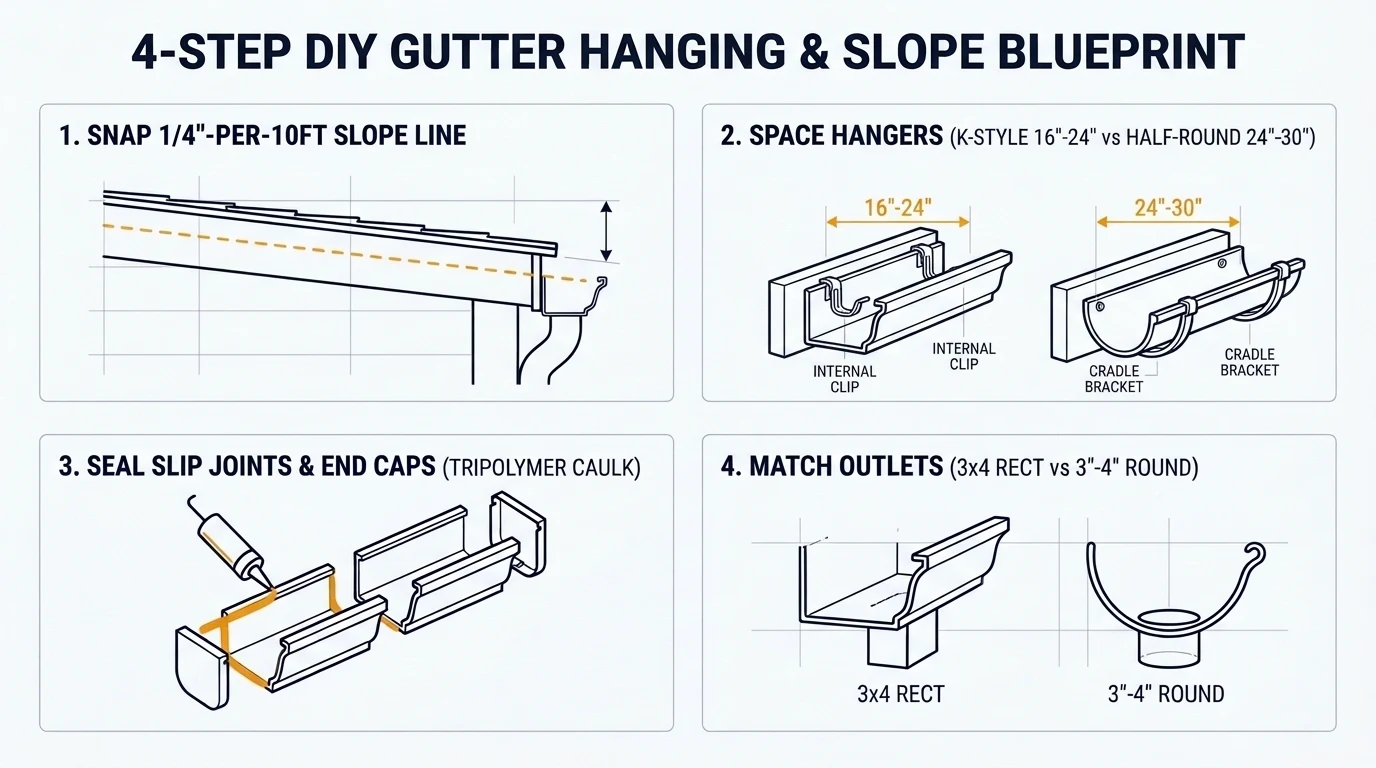
- Step 1 — Snap a 1/4″-Per-10-Foot Chalk Pitch Line on Fascia: Mark your high point roughly 1 inch below the roof drip edge (leaving room under steep metal or shingle overhangs), then measure down 1/4 inch for every 10 feet toward the downspout drop outlet and snap a crisp chalk line across the fascia trim. Keep continuous runs capped at 50 feet maximum without an expansion gap or opposing slope split.
- Step 2 — Pre-Space Hangers by Profile & Snow Zone: Anchor K-style hidden hangers (with structural hex screws hitting fascia/rafter tails) every 24 inches O.C. in mild climates or every 16 inches O.C. in snow/ice regions. For half-round fascia cradle brackets, space them every 30 to 32 inches O.C. in mild weather and tighten to 24 inches O.C. where winter ice accumulates.
- Step 3 — Clean, Dry & Seal Sectional Slip Joints and End Caps: Wipe raw aluminum or steel seam overlaps with isopropyl alcohol, apply a continuous bead of elastomeric tripolymer gutter sealant (such as Geocel 2320—not standard household silicone) inside the slip joint and end-cap groove, press joints tightly together, and lock seam tabs with stainless zip screws or pop rivets.
- Step 4 — Cut Oversized Drop Outlets Before Hanging Guards: Match outlet openings directly to roof runoff volume—install 3″x4″ oversized drop outlets on busy K-style roof corners (or 4″ round drops on 6″ half-round troughs) so downspouts clear leaves without backing up water along seam joints.
Essential DIY Gutter Hanger, Sealant & Cutting Hardware Kit
Internal aluminum brackets with pre-inserted #10 hex screws spaced cleanly at 16″–24″ O.C. to lock K-style rims without visible exterior straps.
Wrap-around cradle brackets designed to maintain semicircular half-round alignment under rain and winter ice at 24″–30″ spacing.
Sticks permanently to damp or mill-finish aluminum slip joints, end caps, and corner miters through UV and freeze-thaw cycles without shrinking like silicone.
Trims 0.027″–0.032″ aluminum outlet cutouts and drives hanger screws past front gutter hems without denting outer edges.
Frequently Asked Questions
Do 5-inch K-style gutters hold noticeably more water than 5-inch half-round gutters?
Yes. Because K-style gutters have a flat bottom and vertical back wall rather than a curved semicircle, they offer roughly 15% to 20% more cross-sectional area—holding around 1.2 gallons per linear foot in 5-inch K-style versus ~0.9–1.0 gallons per foot in 5-inch half-round.
If I switch from 5-inch K-style to half-round gutters, what size should I install?
Standard architectural practice is to step up one nominal size—installing 6-inch half-round gutters (or adding extra round downspouts) so you match the peak storm-handling workload of a 5-inch K-style run.
Which aluminum thickness gauge is better for snow climates: 0.027″ or 0.032″?
For northern freeze-thaw snowbelts or steep metal roofs that shed heavy ice, choose 0.032-inch aluminum. While 0.027-inch aluminum is standard on mild-climate builder homes, heavier 0.032-inch metal resists ladder dents, screw tear-out, and winter ice distortion far better.
How far apart should K-style hidden hangers vs. half-round brackets be spaced?
Space K-style hidden hangers at 24 inches on center (tightening to 16 inches O.C. in heavy snow/ice zones). Traditional half-round cradle or bar brackets typically span 30 to 32 inches O.C. in mild climates and 24 inches O.C. in snow zones.
Can I install Raptor or EasyOn micro-mesh gutter guards on half-round gutters?
No—standard K-style micro-mesh rails rely on flat back flanges and rolled K-style front noses. Half-round owners should use dedicated half-round clip screens or cylindrical GutterBrush bristle guards (4.25″ diameter for 5″ gutters, 5.25″ for 6″ gutters).
Why are half-round DIY gutter projects more expensive than K-style?
Beyond slightly higher linear-foot trough prices (~$5.00–$9.50/ft aluminum vs. ~$3.50–$7.00/ft for K-style), decorative half-round brackets, cradle hangers, slip connectors, and round downspout outlets typically add 20% to 40% more to total hardware costs.

Every gutter guard, telescoping wand, and drainage fitting covered by the FixItRig Editorial & Engineering Research Staff is audited against official manufacturer specifications, verified long-term homeowner feedback, and SMACNA, IRC, and OSHA residential building codes. Before publishing or updating any guide, our US editorial team cross-checks thread diameters, material gauges, and outlet fitment so homeowners buy the right hardware the first time.
Affiliate Disclosure: As an Amazon Associate, FixItRig earns from qualifying purchases made through links on this page at no additional cost to you.